A pool barrier should not be the part of the project that compromises everything else. Not the sightline from the terrace. Not the landscape plan. Not the speed of daily use. For high-end residential and hospitality environments globally, from Sydney to Dubai to Cape Town to Tuscany, that is exactly why interest in smart pool fence remote control systems has grown. They offer controlled protection without leaving a permanent visual obstacle around the water.
What matters, though, is not the remote alone. It is the system behind it. A remote-controlled pool fence only delivers real value when the barrier is physical, reliable, and designed for compliant operation. Convenience is attractive. Certified protection is the reason the system belongs in the specification.
The global smart home context
Smart pool fence remote control does not exist in isolation. It sits within the broader movement toward home and property automation that has reshaped how premium residential and hospitality properties operate globally.
The global smart home market reached approximately $164 billion in 2026, with the security and access control segment accounting for over 29 percent of revenue. In every major luxury residential market, controlled access to the property and its amenities is the category where automation has been adopted earliest and most thoroughly.
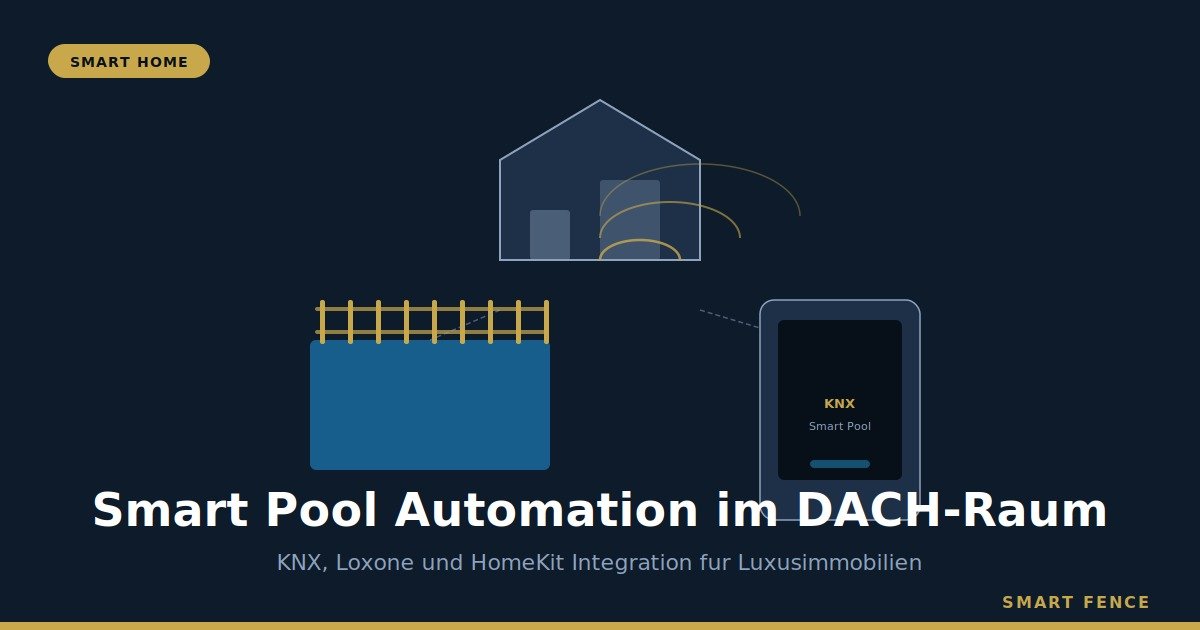
The penetration of smart home technology differs by market. In Germany, Austria, and Switzerland, KNX, the European open standard for building automation, dominates premium residential and commercial installations. KNX networks control lighting, blinds, climate, access, and security in high-end properties across this region, and pool barrier integration through KNX dry contacts is a natural extension of the existing infrastructure.
In Australia, C-Bus by Schneider Electric has been the leading home automation protocol in the luxury residential market for decades. Premium Sydney and Melbourne properties with C-Bus networks expect pool safety systems to participate in that ecosystem rather than operating as standalone products.
In the UAE and Gulf, Crestron and Control4 are the dominant platforms in luxury villa and hospitality projects. Dubai’s premium villa market in Palm Jumeirah, Emirates Hills, and Jumeirah Golf Estates routinely includes centralized building management systems where pool access is one of many controlled variables.
In the United Kingdom, the luxury residential automation market uses a mix of Control4, Crestron, Savant, and Lutron systems. In high-end properties in London’s prime boroughs and in country houses, pool safety integration through smart home protocols is an increasingly expected feature.
In Singapore and Hong Kong, dense urban luxury developments include centralized building management systems where access control is a primary function. Pool barrier integration is part of a broader security and access automation layer.
The protocol-agnostic dry contact outputs that Smart Fence provides connect to any of these platforms without a proprietary bridge. The barrier becomes a participant in the property’s existing automation logic rather than an isolated product with its own control system.
What a smart pool fence remote control actually does
A smart pool fence remote control activates a retractable safety barrier around the pool perimeter. Instead of relying on a fixed fence that remains visible at all times, the system rises when protection is needed and retracts into concealed below-ground housing when open access is appropriate.
That distinction is critical. This is not a gadget layered onto a standard fence. It is a controlled architectural safety system. The remote is the user interface for a barrier engineered to create real physical separation between the pool and the surrounding space.
For homeowners, that means faster response during daily use. When children are present, the fence can be raised immediately. When the pool is in supervised use or the outdoor area is being used for entertaining, the barrier retracts fully out of view. For hotels and private villas, controlled deployment allows staff to manage access with more consistency than manual handling allows, and remote operation removes the dependency on a staff member being physically present at the fence.
Why remote control matters more than convenience: the behavioral case
Remote activation sounds like a comfort feature, but in practice it is a behavior change mechanism. The easier a safety barrier is to use, the more likely it is to be used correctly and at the right time. That relationship is documented across behavioral economics research consistently.
The UK Behavioural Insights Team, one of the world’s leading applied behavioral science organizations, identifies friction reduction as one of the most consistently effective interventions available. The principle is that removing effort barriers to a desired behavior increases the frequency with which that behavior occurs. This is documented across tax compliance in Denmark, vaccination uptake during COVID-19, organ donation registration in multiple European countries, and energy conservation programs in the UK and Australia.
Applied to pool safety: a barrier that takes seconds to deploy is deployed more consistently than one that takes minutes. A gate that closes automatically is closed more consistently than one that depends on someone waiting for it to swing shut. A system whose status is remotely verifiable produces more reliable deployment behavior than one where the only way to know the gate is closed is to walk to the pool.
This behavioral dimension is not cultural. It is universal. The friction that causes safety systems to fail in family homes in California causes the same failures in villa environments in Bali, managed properties in Cape Town, and resort operations in Dubai. The remote control that eliminates that friction works the same way in every market.
The three control modes and their global use cases
A well-specified retractable pool fence system provides three distinct control modes, each suited to different property types and operational patterns across global markets.
Dedicated remote control is the primary interface for most private residences globally. It requires no connectivity, no authentication beyond physical possession, and no device other than itself. For a family home in Sydney, a villa in Tuscany, or a private residence in Dubai, the remote is the fence equivalent of a car key. One press to raise, one press to lower. Secure by physical possession.
Mobile app control extends capability to situations where the remote is not at hand or the owner or manager is off-site. This is most valuable in the international luxury property market, where owners frequently manage second homes or investment properties from a distance. A property in the south of France managed from London, a villa in Bali owned by a Singapore-based buyer, or a Cape Town holiday home managed remotely all benefit from app-based status verification and deployment control. The app also supports multi-user access with differentiated permissions: estate manager, cleaning service, guest.
Smart home integration through dry contact outputs is the most powerful control mode for complex properties and professionally managed environments. The four dry contact outputs from the Smart Fence controller connect to any automation platform without a proprietary bridge. The barrier’s state becomes part of the property’s automation logic: deploying as part of a departure scene in a KNX system in Germany, appearing on the pool management dashboard of a Crestron system in a Dubai villa, triggering an alert in a C-Bus system in a Sydney harbourside home when the fence remains lowered past a defined time.
For hospitality operators across all markets, this integration allows the pool barrier to be part of changeover protocols, shift handover procedures, and security monitoring systems. The barrier state is visible, verifiable, and auditable without requiring a staff member to physically check the pool perimeter.
Smart pool fence remote control and compliance
The right question is not simply whether the barrier can be opened and closed remotely. It is whether the full system is built to support compliant pool barrier performance in the applicable jurisdiction.
Pool safety regulations vary significantly by country, and the compliance path for remote-controlled retractable systems differs by market. In France, where the Raffarin Law permits physical barriers without a permanence requirement, the remote control is simply the activation interface for a compliant barrier. In Australia, where AS 1926.1 requires a permanent structure, the compliance conversation requires engagement with the local council regardless of how the barrier is controlled. In South Africa, the UAE, and most US jurisdictions, the compliance evaluation focuses on the deployed-state performance: does the raised fence meet height, gap, and gate requirements? The remote control is the mechanism by which the deployed state is achieved.
In all markets, remote control must be secured against unauthorized operation. The concealed activation button positioned at adult height on the gate handrail prevents children from lowering a deployed barrier from pool level. App access requires device authentication and credentials. Smart home integration can restrict operation to authorized users and time windows. The control system should be designed to prevent the barrier from being lowered by anyone other than an authorized adult, regardless of which control interface is used.
Design impact: where these systems stand apart globally
Traditional pool fencing solves one problem by creating another. It protects the water but disrupts the architecture. That tension is felt in every premium pool market globally, whether the architecture is a modernist glass box in Sydney, a limestone villa in Provence, a minimalist villa in Bali, or a contemporary estate in the Cape Winelands.
A retractable remote-controlled barrier changes that equation. When not required, the fence disappears into its below-ground housing. The pool edge reads cleanly. The sightlines that defined the outdoor composition remain intact. The landscape does not have to accommodate a permanent enclosure.
For luxury residences globally, this preserves the relationship between home, terrace, and water. For boutique hotels and resort settings from the Maldives to the Algarve, it protects the guest experience while still allowing management to impose a physical barrier when conditions require it.
Material durability across global deployment environments
A smart pool fence remote control system is only as reliable as the mechanism that responds to its commands. The electronic and mechanical components of the system must perform across the full environmental range of global deployment.
In the Gulf (UAE, Saudi Arabia, Qatar), surface temperatures can exceed 70 degrees Celsius on exposed pool decks in summer. Electronic components must be rated for high ambient temperature. Below-grade housing must be designed for ventilation and thermal management in addition to drainage.
In Australia, UV radiation intensity is among the highest globally. Polymer components and cable insulation must be UV-stabilised. Coastal installations in Queensland, NSW, and WA require marine-grade hardware specifications.
In Southeast Asia (Bali, Thailand, Vietnam), tropical humidity, heavy seasonal rainfall, and high temperatures create an aggressive combined exposure. The drainage system from each housing unit is especially critical in tropical markets where rainfall can be intense and frequent.
In South Africa, coastal Atlantic and Indian Ocean installations require marine-grade specifications. Interior installations face different challenges: high UV, extreme temperature variation, and in some regions expansive soils that affect below-grade housing stability.
In Northern Europe (UK, Germany, France north of Paris), moisture, freeze-thaw cycling, and lower UV allow standard polymer specifications, but drainage is critical for standing water management in cold seasons.
The control electronics are housed in the controller unit positioned in a dry indoor location away from the pool equipment room, which provides the primary environmental protection for the system’s active components. The below-grade housing units and their drainage systems are the primary weathering protection for the mechanical components. Both must be correctly specified for the specific site environment.
Where smart remote-controlled pool fencing fits best globally
This category makes the most sense where visual quality, risk control, and operational sophistication all carry weight simultaneously. High-end residential properties with pools as design focal points are an obvious fit in every warm-climate market: Sydney harbourside homes, Dubai Emirates Hills villas, Cape Town Atlantic Seaboard residences, and French Riviera properties.
Hospitality environments are equally compelling across all markets. A Bali resort pool that shifts from family swim to event space to maintenance access needs operational flexibility that a permanent fence cannot provide. A boutique hotel in Tuscany where the pool terrace is the primary selling image in every marketing photo benefits from a barrier that disappears when the camera is pointing at the water.
For architects and developers working across international markets, the value is clearest when the barrier is treated as part of the design coordination from the start. A concealed system specified early preserves design intent while addressing code and operational requirements at the project level, regardless of which country’s regulatory framework applies.
Smart Fence is designed for exactly that brief in every market it serves: below-ground housing flush with the surrounding finish, automatic gate closure within 20 seconds of use, LED perimeter lighting that confirms system state, remote and app control with secure authentication, dry contact outputs for smart home integration in any protocol, and formal handover documentation structured for the compliance requirements of the applicable jurisdiction. The remote makes the system practical. The engineering makes it safe. The documentation makes it defensible.