A permanent pool fence solves one problem and creates another. It protects the water, but it also cuts through sightlines, hardens the landscape, and asks architecture to work around a barrier that never leaves. That is why an automatic retractable pool fence cost breakdown matters at the specification stage, not after the pool is finished. For luxury homes, villas, and hospitality settings across every market, price is tied to more than fence length. It reflects engineering, concealment, compliance, controls, and how cleanly the system disappears when protection is not needed.
What an automatic retractable pool fence cost breakdown actually includes
This category is not priced like a standard removable mesh fence or a simple gate package. An automatic retractable system is a built-in architectural safety system. It rises from a concealed below-ground housing, forms a physical barrier around the pool, and retracts fully out of sight when deactivated. That changes the cost structure across every market where it is specified.
In practical terms, the budget includes design review, custom layout planning, below-ground housing and drainage, the fence mechanism, control hardware, power connection, installation, calibration, testing, and handover documentation. If the pool geometry is irregular, the system requires more customization than a straight rectangular run. Retractable systems are priced as site-specific packages rather than per-unit quantities, because the site preparation and integration scope varies more than the product itself.
Global reference pricing: what conventional pool fencing costs by market
Understanding where an automatic retractable system sits in the cost hierarchy requires knowing what the conventional alternatives cost in each major pool market. These benchmarks give context for the premium a concealed, automated system carries and what it delivers in return.
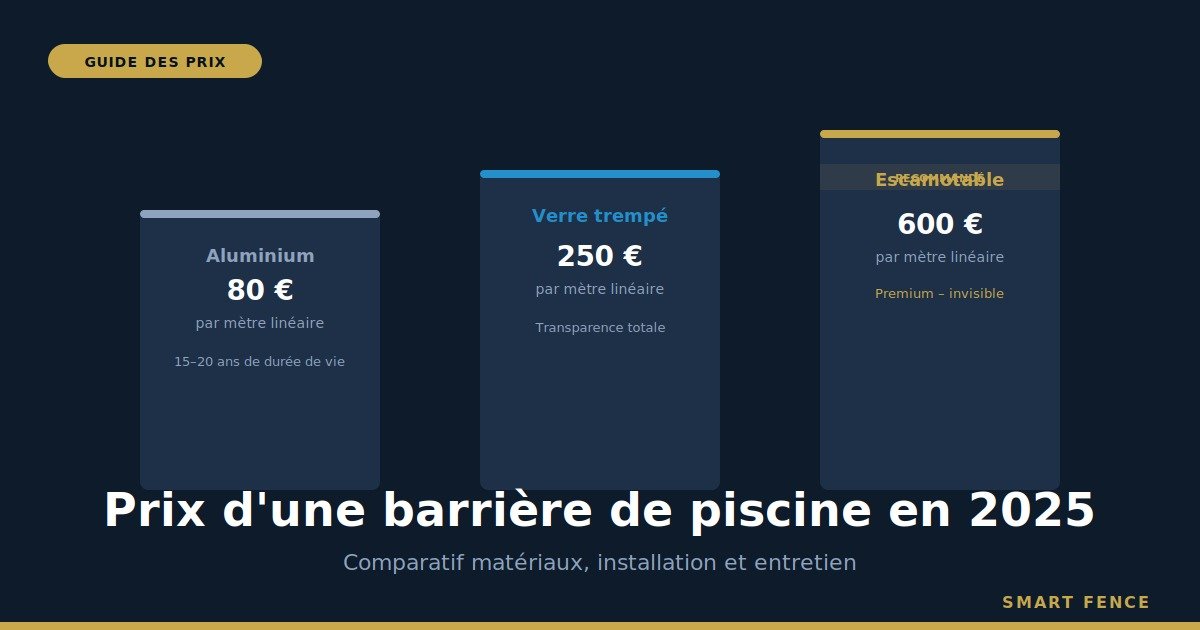
United States. Mesh pool fencing typically ranges from $17 to $35 per linear foot installed. Aluminum fencing typically ranges from $32 to $57 per linear foot. Glass fencing commonly starts around $90 per linear foot and can go much higher for frameless installations. For a typical residential pool perimeter of 50 to 60 linear feet, total conventional fence costs range from approximately $1,500 for basic mesh to $10,000 or more for premium frameless glass. Luxury frameless glass in markets like Los Angeles runs $353 to $441 per linear foot installed for the premium segment.
Australia. Pool fencing costs in Australia for 2025 range from approximately A$180 to A$600 per linear metre installed, depending on material. For a typical residential pool requiring 20 metres of fencing, homeowners can expect to invest between A$3,600 for basic aluminium and A$12,000 or more for premium frameless glass installations. Glass pool fencing can cost between A$250 and A$600 per metre or more, with frameless options at the top of that range and gate installations running A$400 to A$900 depending on style. Australia’s high labor costs, driven by skilled trade rates and compliance certification requirements under AS 1926.1, mean that installation labor accounts for a larger share of total cost than in most other markets.
UAE and Dubai. Pool fence installation costs in Dubai range from AED 150 to AED 250 per linear metre for aluminium, AED 120 to AED 200 per linear metre for mesh, and AED 250 to AED 500 per linear metre for glass fencing. At current exchange rates, glass fencing in Dubai runs approximately $68 to $136 per linear metre, meaningfully below equivalent specifications in the US or Australia. This reflects Dubai’s lower labor cost base, though material import costs for premium glass and marine-grade stainless hardware partially offset the labor differential. For villa projects in Palm Jumeirah, Emirates Hills, or Arabian Ranches, the total conventional fence budget for a typical pool perimeter typically falls in the AED 15,000 to AED 50,000 range, varying substantially by material and gate configuration.
South Africa. In Pretoria and Johannesburg, mesh fencing costs approximately R300 to R500 per linear metre installed. Glass fencing ranges from R2,000 to R3,500 per linear metre. Safety gate installation costs around R22,500, with mesh panels priced between R1,500 and R2,250 per panel. South Africa’s lower labor cost base makes glass fencing relatively accessible compared to Australian or US pricing in local currency terms, but import-dependent premium materials still carry significant cost in ZAR.
United Kingdom. The UK pool fencing market is smaller than Australia, the US, or South Africa, concentrated in luxury residential and hotel pool installations in southern England. Installed glass fencing in the UK typically runs £150 to £400 per linear metre, with frameless designs at the top of the range. Premium aluminium runs £80 to £180 per linear metre. The combination of UK labor rates and the absence of mandatory national pool fence requirements (which reduces price competition) means the UK is broadly comparable to Australian pricing at the premium end.
France. In France, mesh fencing starts at approximately €50 per metre, with gates from €420. Metal fencing runs from €85 per metre and upwards, with gates from €420. Glass fencing panels range from €150 to €300 per metre, with gates from €600. France’s pool fence market is substantial, driven by the Raffarin Law (2004) creating mandatory compliance demand across the large French residential pool stock. Labor costs are moderate by European standards, making France one of the more price-competitive European markets for glass fencing.
Core cost drivers for automatic retractable systems
Pool perimeter and layout complexity
Perimeter length is the first pricing variable, but not the only one. A long, straight edge is typically more efficient to engineer and install than a freeform pool with curves, steps, water features, or multiple access points. Every deviation in geometry affects modular planning. More corners, more transitions, and more tailored sections increase both fabrication and installation time. Irregular perimeters typically add 10 to 15 percent to material requirements compared with rectangular configurations. If the fence must follow a highly specific architectural line while preserving hardscape materials and drainage performance, that precision carries additional cost.
Concealed below-ground construction
This is where many budgets shift regardless of market. A retractable system requires space below the finished surface for housing, mechanics, and controlled movement. If the system is specified during new build construction, coordination is cleaner and typically more cost-efficient. Added later to a completed deck, demolition, modification, and utility relocation can push costs significantly higher.
Site conditions drive this premium differently in each market. Sandy soil in Dubai requires larger concrete beds to resist lateral movement. Expansive clay in South Africa’s interior requires deeper concrete to resist seasonal heave. Limestone substrates common in Mediterranean markets offer good bearing but can be harder to cut. Pool tile or travertine coping in luxury installations requires careful hand work around the housing units regardless of location.
Market-specific labor and compliance premiums
Labor costs vary more than material costs across global pool fence markets. A comparable installation is more expensive in Sydney or London than in Dubai or Cape Town, reflecting local skilled trade rates and cost of living differences. Compliance-related costs also vary: Australia’s mandatory AS 1926.1 inspection and certification requirement adds a professional compliance cost to every installation that does not exist in markets with no mandatory inspection regime.
For automatic retractable systems specifically, commissioning and calibration require trained installation personnel regardless of market. The consistency of that commissioning determines the system’s long-term performance, and it cannot be substituted by local unlicensed labor in any market.
Automation and control package
Automatic operation is a premium feature, but it is also the feature that makes the system worth specifying. Secure remote activation, app-based control, and smart home integration through protocol-agnostic dry contact outputs require integrated electronics, motorization, safety logic, and commissioning. These components perform the same function in every market, and their cost does not vary significantly by geography. What varies is the electrical connection standard: AS/NZS 3000 in Australia and New Zealand, IEC 60364 in EU countries, UAE DEWA standards in the Gulf, SANS 10142 in South Africa, and NEC in the US. The licensed electrician cost to connect the system to local standards differs between markets.
Compliance and documentation
When a system is being specified for a luxury residence or guest-facing property in any market, documentation carries commercial value. Testing, formal handover records, and compliance-oriented documentation are part of the real cost picture. In Australia, this includes materials for the licensed pool safety inspector who issues the compliance certificate. In France, it includes AFNOR product certification documentation. In the US, it includes permit documentation and pre-pour inspection coordination where required.
Typical budget ranges and what drives them
A true automatic retractable pool fence is priced as a premium architectural system rather than a commodity product in every market. The budget structure is consistent globally: design and layout customization, civil preparation and drainage, the mechanism and control package, power connection and commissioning, and handover documentation.
For a smaller residential pool with favorable site conditions and a straightforward layout in a new build, costs may begin in the low five figures USD equivalent in most markets. For larger pools, complex geometries, retrofit conditions, or hospitality-grade installations in any market, pricing moves substantially higher. In many luxury applications globally, the total installed investment falls in the mid to upper five figures and can exceed that where site work is extensive or where premium finishes require careful matching and restoration.
The range is wide because the scope varies more than the product. An installation during new construction with coordinated concrete, electrical, and drainage planning is a different exercise than retrofitting a finished outdoor space with luxury stone, mature landscaping, and limited equipment access, regardless of whether the project is in Sydney, Dubai, or Johannesburg.
Installation costs are often underestimated in every market
New build versus retrofit
New build coordination produces the cleanest result and the most controlled budget in every market. The housing can be planned into the deck assembly, power can be routed in advance, and adjacent trades can coordinate tolerances. A retrofit is almost always more expensive because existing finishes must be cut and repaired, drainage may need rerouting, and power may be farther away than expected.
This cost differential is more pronounced in markets with expensive labor, including Australia, the UK, and northern Europe, where skilled trade day rates make retrofit rework disproportionately costly. In markets with lower labor costs, including South Africa and parts of Southeast Asia, retrofit premiums are smaller in absolute terms.
Surface finish restoration
High-end pool projects globally use large-format stone, custom tile, hardwood decking, or detailed coping. When those surfaces must be opened and restored around concealed housing units, labor and material costs rise in proportion to the finish quality. The cost of restoration to an invisible standard, where the housing is indistinguishable from the surrounding deck, is highest in markets with expensive skilled trade labor and highest-quality materials.
Ongoing costs after installation
An automatic retractable pool fence is not a high-maintenance product, but it is a mechanical and electrical system in an exposed environment. Owners should budget for periodic inspection, drainage clearing as part of seasonal maintenance, and service checks to confirm reliable deployment and gate function.
Maintenance costs vary by market primarily through labor rates. Annual service visits in Sydney or London cost more in currency terms than equivalent visits in Dubai or Cape Town, but the service scope is the same globally: drainage inspection, gate timing verification, LED function check, and control interface verification.
Long-term costs are modest relative to initial installation in any market, but they protect both safety performance and the visual precision that makes the system worth its premium. A well-maintained hidden fence continues to deploy cleanly, retract completely, and document its condition over time. A neglected system develops drainage blockages, mechanism noise, and eventual deployment failures that are more expensive to remediate than the maintenance they replaced.
The value frame: what you are paying for globally
The premium for an automatic retractable system over conventional alternatives is consistent across markets as a multiplier: it sits above removable mesh and aluminum, above conventional glass, and at the top of the pool barrier cost hierarchy in every geography.
What that premium delivers is also consistent globally: a pool environment that presents at its architectural best when protection is not required, a gate function that cannot be bypassed through forgetfulness or inconvenience, and a documentation record that supports regulatory compliance in whatever jurisdiction the project sits.
For homeowners and developers investing in premium property in any market, the relevant comparison is not “what does the cheapest compliant barrier cost?” It is “what is the cost of a barrier that protects the design investment I have made in this outdoor environment, and does not compromise it the moment safety is required?”
Smart Fence approaches this as an engineered architectural system in every market it serves: below-ground housing flush with the surrounding finish, automatic gate closure within 20 seconds of use, LED perimeter lighting that confirms system state, remote and app control with secure authentication, dry contact outputs for smart home integration in any protocol, and formal handover documentation structured for the compliance requirements of the project’s jurisdiction.