A beautiful pool can lose its entire architectural effect the moment a bulky barrier cuts across the view. That is the real challenge behind choosing a pool fence with minimal visual obstruction: the fence still has to function as a true safety system, not just look discreet in photos.
For luxury homes, boutique hospitality settings, and architect-led outdoor spaces, that distinction matters. A compliant pool barrier must do more than disappear visually. It has to create a credible physical boundary, operate reliably, and fit the geometry of the site without compromising circulation, materials, or sightlines. Minimal visual impact is the goal. Certified protection is the standard.
What pool fencing actually prevents — and why the numbers matter
Before considering what a barrier looks like, it helps to understand what it does. Four-sided isolation fencing can reduce a child’s drowning risk by up to 83% compared to three-sided property-line fencing. That figure is not a marketing claim. It is the result of decades of epidemiological research that began after a preventable public health crisis.
By the early 1970s, preformed fibreglass pools became widely available to households and the rate of drowning for young children jumped enormously. Australia documented the problem more rigorously than most countries: at the peak, seven children per year were drowning in pools in Brisbane alone. The national response was legislative. In 1972, South Australia passed the Swimming Pools (Safety) Act 1972, the first piece of legislation in Australia to specifically require safety barriers for private swimming pools. Other states followed over subsequent decades, progressively tightening requirements as evidence on barrier design accumulated.
The critical statistical point is not just that fencing works, but why timing matters so much. Research shows that 77% of child drowning victims were missing for five minutes or less when found, and 70% were not expected to be near water. The risk is not absent-mindedness or neglect. The danger is the extreme speed at which a tragedy unfolds during ordinary distractions like a phone call, a conversation, or a bathroom trip. Within 20 to 30 seconds, submersion or airway compromise can occur. Within one to two minutes, loss of consciousness becomes possible as oxygen levels drop.
This context changes the conversation about pool barriers. A fence that is inconvenient to operate or is routinely left open is not a design detail. It is a safety failure waiting to happen. Pool fencing was only found to be effective when accompanied by a self-closing and self-locking gate, and effectiveness is further affected by fence height, footholds, view of the pool, and the direction in which the self-closing gate should open.
What a pool fence with minimal visual obstruction actually means
In practice, a low-visibility pool fence is not defined by transparency alone. Glass panels may preserve sightlines, but they still establish a permanent visual edge around the pool. Slim-framed metal fencing can feel lighter than conventional barriers, but it remains constantly present in the landscape. Mesh options can reduce visual weight compared with heavier enclosures, yet posts, anchors, and stored sections still affect the overall composition.
That is why the best answer often depends on when the barrier needs to be visible. If protection is required full-time, the design question becomes how to minimize visual mass. If the pool is used in a controlled residential or hospitality setting where the barrier only needs to be active at specific times, the stronger design move may be a retractable system that is physically present when needed and absent when not.
Minimal obstruction, then, is not only about material choice. It is about visual presence across the full life of the space.
Why permanent fencing often conflicts with design intent
Most pool projects are designed around openness. The water line is meant to connect with the terrace. Planting is meant to frame the pool, not sit behind a second layer of verticals. Views from inside the home are often organized around the outdoor axis, with the pool acting as a focal element.
A permanent fence interrupts that intent in several ways. First, it creates a fixed line that the eye has to read before it reaches the water. Second, it adds hardware: posts, gates, latches, hinges, base shoes, and anchors that can compete with refined paving and landscape detailing. Third, it introduces operational friction. If a barrier is always there, users begin working around it rather than experiencing the space as designed.
For architects and developers, this is not a cosmetic issue. It affects how the project is perceived at completion. For homeowners and hospitality operators, it changes how the space is used every day.
The hidden maintenance cost of “transparent” fencing
Glass pool fencing is often specified as the no-compromise solution: full transparency without the mass of traditional barriers. In many projects that logic holds. But glass enclosures in outdoor pool environments carry a maintenance profile that is often underestimated at the specification stage.
Salt air, UV radiation, temperature fluctuations, and moisture can quickly degrade low-quality materials, even if they appear suitable at installation. Frameless and semi-frameless systems rely on stainless steel fixings, spigots, and hinges that are in constant contact with pool chemistry and outdoor conditions. Saltwater chlorination systems produce a salt mist that settles on surfaces and accumulates over time, building up mineral deposits on glass and speeding up steel oxidation.
The glass itself requires more active maintenance than is commonly anticipated. Water spotting, calcium deposits from splash patterns, and surface etching from chemical contact all affect clarity over time. A glass barrier that looked immaculate at handover may need professional cleaning every few months to maintain the transparency that justified the specification.
This does not make glass fencing a poor choice. For permanent enclosures in controlled conditions, it remains one of the strongest design-led options available. But it does mean that minimal visual obstruction through glass is conditional: it depends on maintenance that many owners underestimate or defer.
The design case for a retractable pool fence with minimal visual obstruction
A retractable pool fence solves a more specific problem than a standard barrier. It does not merely reduce bulk. It removes visual dominance from the equation by storing the system below grade when not required.
That difference matters because it allows the pool environment to return to its intended state. Open deck lines remain open. Planting beds are not segmented by fencing. Water features, view corridors, and material transitions can be read as a complete composition rather than one filtered through a safety perimeter.
When activated, the fence rises to form a compliant physical barrier around the pool. When retracted, it disappears from view. This approach aligns especially well with high-end residential projects, private villas, and boutique hotels where the outdoor environment is expected to perform at two levels: protective when needed, visually quiet when not.
It is also more compatible with modern planning decisions. Pools rarely follow simple rectangles anymore. They curve around terraces, align with retaining walls, or sit within layered landscape schemes. A modular retractable system can be configured to suit exact geometry, which makes it more realistic for bespoke projects than one-size-fits-all fencing products.
What to evaluate beyond appearance
Low-visibility fencing can look convincing in renderings and still disappoint on site. The details that matter most are usually operational.
Compliance and barrier performance
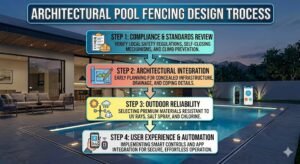
The first question is whether the system creates a legitimate physical barrier aligned with applicable requirements. That includes height, openings, gate logic where relevant, and controlled operation. For hospitality and high-end residential work alike, the barrier should support regulatory review rather than create ambiguity.
A design-led product still needs safety credibility. Documentation, formal testing, and handover records are not extras. They are part of a specification-ready solution.
Integration with architecture and landscape
A fence should not be selected in isolation. It interacts with paving build-up, drainage, coping details, lighting, irrigation, and surrounding hardscape tolerances. A system that appears minimal above ground may require intrusive visible components if integration is poorly resolved.
This is where concealed housing and project-specific coordination become important. The cleaner the integration below the surface, the cleaner the finished environment above it.
Reliability in outdoor conditions
Poolside systems live in harsh environments. UV exposure, water, cleaning chemicals, temperature shifts, and repeated use all put pressure on moving components and finishes. If the fence is motorized or retractable, long-term performance depends on engineered mechanics, calibration, and proper commissioning.
For specifiers, this is not just about warranty language. It is about whether the barrier will operate predictably after seasons of real use.
Ease of operation
A safety barrier that is cumbersome often ends up underused, and that undermines protection. Pool fencing effectiveness depends on the gate logic, including whether it is self-closing and self-locking. Controlled activation through a secure remote or mobile app takes that requirement further: it turns the barrier into an on-demand system rather than a manual inconvenience.
Convenience should not replace safety discipline. But it does support better daily use, especially in homes with children, staffed residences, and hospitality environments where operating procedures matter.
The hospitality context: liability and design are the same problem
For boutique hotels and resort operators, pool safety is not a background compliance issue. Hotels are required to adhere to a set of guidelines and codes that govern the design, maintenance, and operation of their swimming pools, and failure to meet these standards can be a clear indication of negligence and a contributing factor to liability.
The overlap between safety infrastructure and guest experience is significant in luxury settings. A barrier that reads as institutional contradicts the brand positioning that justifies premium rates. But cutting corners on compliance creates legal and financial exposure that far outweighs any savings on specification.
Hoteliers can be held responsible for an incident at the pool if they failed to provide a safe environment for their guests. In practice, this means that every element of the pool environment, including barrier design, gate operation, signage, and maintenance records, can become relevant in the event of an incident. A design-integrated barrier with proper documentation does not just look better. It provides a clearer paper trail demonstrating that the property met its duty of care.
Where different fence types fit
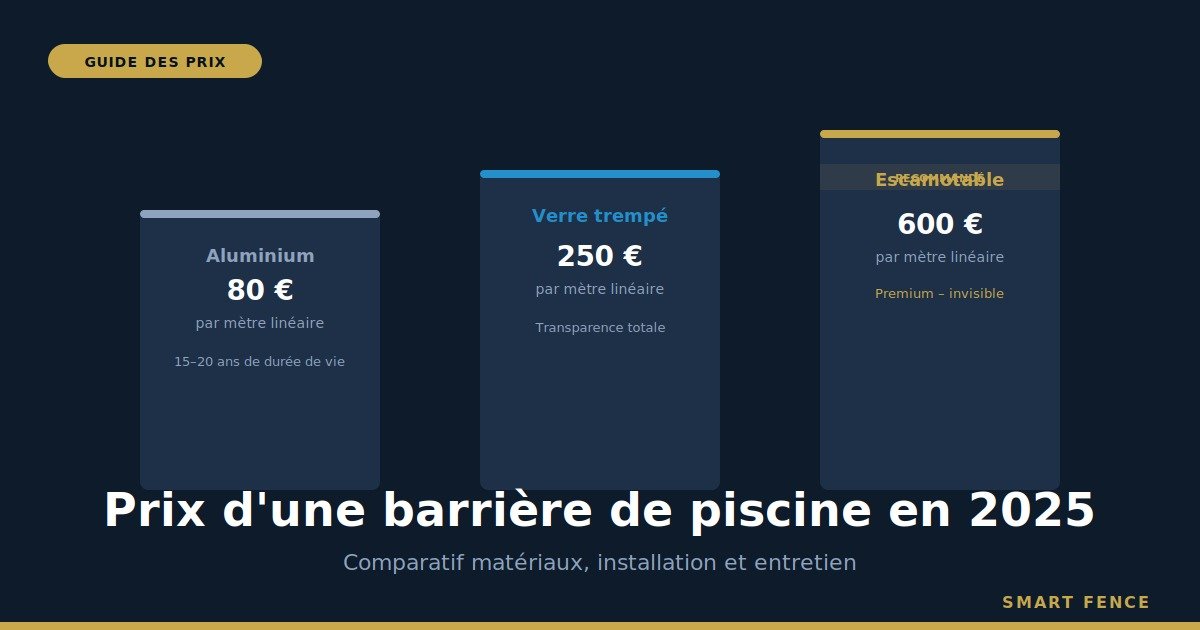
There is no single answer for every project. Glass fencing remains a strong choice when constant enclosure is acceptable and uninterrupted transparency is the main goal. It feels premium, preserves broad views, and can suit contemporary architecture well. The trade-off is permanence: the line of the enclosure never goes away, and outdoor pool conditions impose ongoing maintenance demands that glass requires more than most other materials.
Mesh fences blend into the background, but they do not add the architectural impact that glass does, and they will not boost property value the way glass fencing can. Over time, mesh panels can lose tension and sag, creating potential gaps. They can be practical for families who want seasonal flexibility at lower cost, but they still introduce sleeves, posts, and a more utilitarian appearance.
Decorative metal fencing offers durability and clear boundary definition, especially where code interpretation or broader site security is part of the brief. Its weakness is obvious visual presence.
Retractable systems suit projects where aesthetics and protection have equal status. They generally involve a more specialized installation process and higher upfront investment, but they answer a different level of design requirement: visible protection only when protection is needed.
Installation is where premium systems separate themselves
A truly integrated pool barrier is not an accessory added at the end. It should be considered during design development or, at minimum, before final hardscape execution.
Site preparation matters. Below-ground housing, power connection, drainage coordination, and finish alignment all need to be resolved early. This is especially true for custom pool layouts where fence path, corners, and operational clearances must match the built condition precisely.
That is one reason consultative installation has real value. A project-based approach allows for measurement, calibration, testing, and formal handover rather than a basic product drop-off. In premium environments, that process protects both safety performance and visual finish.
For clients seeking the lowest-profile solution, Smart Fence is built around that exact requirement: a fully automatic retractable pool safety fence concealed below ground when not in use and engineered for compliance, customization, and controlled operation.
Who benefits most from this approach
For affluent homeowners, the appeal is straightforward. Children need protection. The backyard should still feel open, deliberate, and high-value. A barrier that dominates the view solves one problem while creating another.
For boutique hotels and resort operators, the calculation includes liability, guest experience, and brand standards. Safety infrastructure has to perform, but it should not dilute the visual identity of the property.
For architects, landscape architects, and residential developers, the issue is specification integrity. If the pool barrier appears as an afterthought, the whole composition can suffer. A retractable, design-integrated system preserves the original intent while addressing risk in a disciplined way.
The best pool fence is not always the one you notice least in a product catalog. It is the one that delivers protection without forcing the architecture to make visual compromises it never needed to make.