A permanent pool fence solves one problem by creating another. Safety improves, but sightlines disappear, circulation changes, and carefully planned landscaping starts working around the barrier instead of with it.
That is why interest in app-controlled pool fencing is growing, especially in high-end residential and hospitality projects. Owners need a compliant physical barrier. Architects want clean lines. Operators need controlled access that is simple to manage day to day. The right system can answer all three, but only if the app is understood for what it actually is: a control interface for an engineered safety product, not a safety product in itself.
What an app-controlled pool fence actually is
An app-controlled pool fence is a physical barrier that can be activated and managed through a mobile application, typically alongside a dedicated remote control. In the premium segment, that means a retractable fence that rises when protection is required and retracts into concealed below-ground housing when the pool area should remain open.
That distinction matters immediately. App control is not a notification tool or a camera-based alert system. Those products may support supervision, but they do not create a certified physical barrier. If the priority is child safety, liability reduction, and regulatory alignment, the central question is not whether the app is elegant. It is whether the system forms a real, compliant perimeter when deployed, and whether the app makes that perimeter more or less likely to be in place when needed.
The context: most luxury properties already expect this
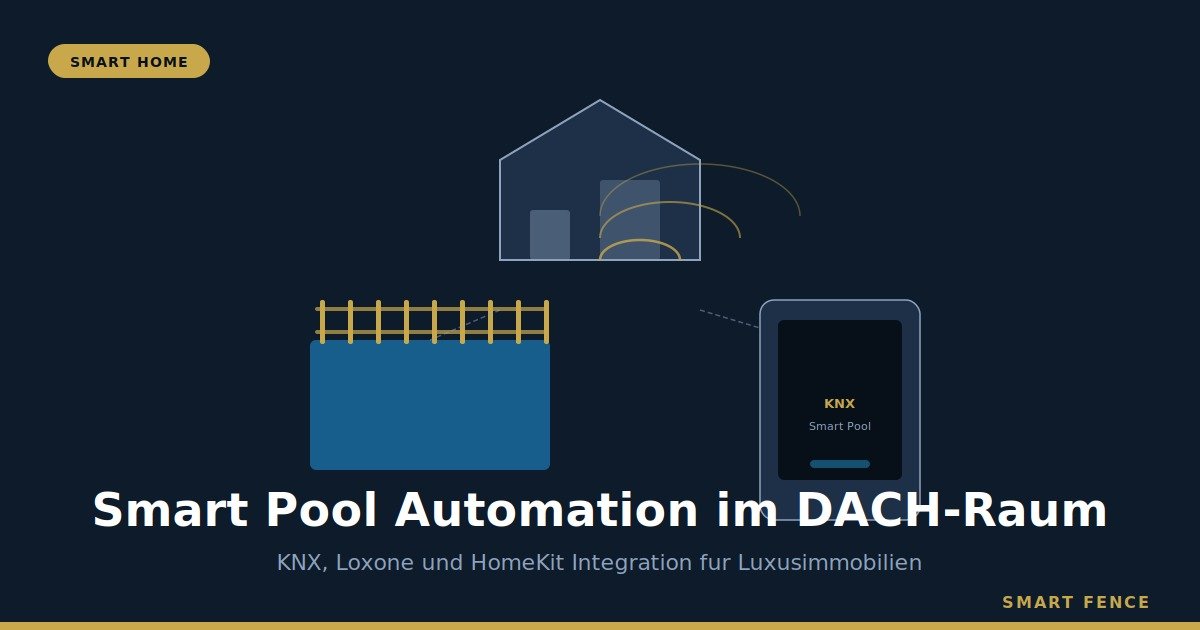
Smart home household penetration in the United States reached 89.5% in 2025 and is projected to reach 99 percent by 2029. In the high-end residential segment that is the primary market for a retractable pool fence, that number is effectively already at saturation. Lighting, climate, security cameras, locks, and entertainment systems are app-managed as a matter of course. A pool barrier that requires a separate physical intervention while everything else in the home is centrally controlled is operationally out of step with the property it serves.
The security and access control segment holds the largest share of the smart home market, accounting for over 29 percent of revenue. Access control is where homeowners have consistently prioritized smart integration, because it directly governs who can reach what. A pool perimeter is an access control problem. The app-controlled fence is, in that framing, the logical extension of access management that already exists elsewhere in the property.
Why app control matters beyond convenience: the behavioral argument
The simplest reason is immediacy. If a pool barrier takes effort to use, people delay it, avoid it, or leave it open. That is where traditional solutions fail in real life. A gate that should be closed gets propped. A manual cover remains off because no one wants the hassle. A removable fence is technically available but not reinstalled after a gathering.
Removing friction is consistently one of the most cost-effective behavioral interventions available. The principle is not providing new information or new incentives. It is removing the effort barriers that prevent people from doing what they already want to do. App control moves pool barrier deployment from a physical task requiring presence at the fence line to a two-tap action from anywhere on the property.
That matters most in the moments when the barrier most needs to be raised: when children move into the garden unexpectedly, when a guest gathering winds down and adult supervision disperses, when the owner is inside and realizes the pool is unattended. In each of those scenarios, the barrier is more likely to be deployed when deployment costs two seconds than when it costs several minutes of walking, installing, and checking.
What the app adds that a remote cannot
A dedicated remote and a mobile app both activate the fence. The differences are in what each adds beyond that core function.
Status confirmation from a distance. A remote tells you when you’ve pressed a button. It does not tell you whether the fence is currently raised or lowered when you’re in a different part of the property. An app with status feedback shows barrier state in real time, so an owner can confirm the fence is up without walking to the pool. In a large villa or a property with multiple outbuildings, that remote visibility is operationally significant.
Management from off-site. A remote works within radio range of the controller. An app with a network connection works from anywhere: another room, the driveway, the airport. For owners of second homes, managers of vacation rental properties, and hospitality operators overseeing a property remotely, off-site operation is a genuine functional advantage. The fence can be raised after a check-out, confirmed before a check-in, and managed without a staff member being physically present at the pool.
Multi-user access with differentiated permissions. A remote is a single physical object: whoever holds it has full access. An app can be deployed across multiple authenticated users with different permission levels. In an estate management context, that might mean the household manager, security staff, and a deputy can all operate the fence independently, while guest credentials are time-limited or restricted. In a hospitality context, the system can distinguish between ownership access, management access, and operational staff access. That layered permission structure cannot be achieved with a physical remote alone.
Integration with broader property management. An app connects the fence to the same operational layer that manages everything else. Staff changeover checklists can include fence state confirmation. A property management system can query barrier status as part of a departure protocol. An alert can be configured if the fence remains lowered past a defined hour. None of that is available through a standalone remote.
The security question: what keeps unauthorized users out?
This is the concern that responsible buyers raise, and it deserves a direct answer rather than a marketing response.
Cloud-connected devices are managed through vendor apps and are increasingly targeted through phishing and credential stuffing. If an attacker gains access to a cloud account through a reused password, they can control any device managed through that account regardless of local network security. That exposure is real and applies to any internet-connected access control product, including pool fence systems that rely on cloud authentication.
The mitigation is equally direct. Enabling multi-factor authentication adds a critical second layer of protection that prevents unauthorized access even if a password is compromised. Strong unique passwords for each vendor account, combined with MFA through an authenticator app rather than SMS, represent the baseline security posture for any smart home system managing access control.
For a pool fence specifically, the consequence of unauthorized remote activation is the fence lowering, not the fence raising. An attacker gaining app access could theoretically lower a deployed fence. That is a meaningful consideration for owners who rely exclusively on app control during periods of elevated risk. The appropriate response is to treat the dedicated physical remote as the primary secured control point for daily family use, with the app serving as the secondary layer for remote management and status monitoring. The two complement each other rather than one replacing the other.
What happens when the app fails
Connectivity-dependent systems have failure modes that physical remotes do not. If the home WiFi is down, if the phone battery is dead, or if the cloud service has an outage, app control may be unavailable.
This is why the dedicated remote is not made redundant by the app. It is the primary activation method for on-site users. It requires no connectivity, no authentication, and no device other than itself. The app adds capabilities the remote cannot provide. The remote ensures the system is operable regardless of network state.
The fence itself does not depend on app connectivity to maintain its position. A deployed fence stays raised whether or not the app is accessible. A retracted fence stays retracted until a control input is received through any authorized channel. The system’s safety state is held by the mechanical barrier, not by the connectivity layer.
Where app-controlled pool fencing fits best
Not every property needs remote app management on top of a dedicated control. For some projects, a fixed code-compliant fence and a physical remote serve every operational need without additional complexity.
The app layer pays for itself most clearly in these contexts:
Second homes and vacation properties. The owner is not present between stays. Pool state needs to be managed and confirmed remotely. Staff may be on-site without the owner, and access needs to be auditable.
Boutique hotels, villas, and managed rentals. Multiple authorized users need controlled access at different permission levels. Changeover protocols need to include pool barrier state. Remote oversight is part of professional property management.
Large primary residences with estate management. The household team is larger than the immediate family. Shift rotations, staff turnover, and distributed responsibility mean that a single physical remote is insufficient for reliable access control across the full operational day.
Architect-led projects where the pool is the design focal point. The client’s instinct is to never compromise the space. App control makes the barrier invisible in both senses: below the floor when not needed, and managed from a phone when needed rather than by going to the fence.
For a straightforward family home with the same adults managing the pool daily, the remote is the better primary interface and the app is a genuinely useful secondary. Treating the app as the primary control for a family with young children introduces unnecessary dependency on connectivity and authentication steps at the moments when speed is most important.
Compliance, liability, and the limits of smart features
An app does not make a pool safe. A sensor does not replace a barrier. Remote control does not override code requirements.
Pool barrier requirements vary by jurisdiction. Fence height, climb resistance, gate behavior, barrier continuity, and access conditions can all affect approval. The app-controlled interface must be evaluated against those requirements, not instead of them. In most jurisdictions, what is assessed is the physical barrier: its height, gaps, gate operation, and installation. The control interface is secondary to those specifications.
For homeowners, this reduces to a practical point: the app must control a system that is already specified correctly for the project’s compliance path. For hospitality operators, the documentation trail that accompanies a formally installed and commissioned system is more valuable than the app feature list. If an incident is reviewed, the evidence is the calibration record, the handover documentation, and the maintenance log. The app is the interface. The documentation is the protection.
The direct answer to “is it worth it?”
For a luxury primary residence with on-site adults managing the pool daily: the dedicated remote is the workhorse. The app adds genuine value as a secondary layer for status confirmation, off-site check, and multi-user access. The combination is stronger than either alone, and the marginal cost of adding app capability to a system already built for remote control is low.
For a vacation rental, managed property, hospitality setting, or second home: the app is not optional. It is the primary operational tool for a property where the owner and manager are frequently off-site and where access control needs to be distributed across a staff team. The return on that capability is measured in operational reliability, not feature count.
For a modest residential pool where the fence will stay visible and the same person manages it every day: a fixed fence and a physical gate handle the brief. The app adds complexity that is not justified by the operational pattern.
The useful question is not whether app control is impressive. It is whether the operational pattern of the property makes remote status confirmation, off-site management, and multi-user permissions a daily practical need. For the category of client who specifies Smart Fence, that answer is usually yes, and the app is part of what makes the system behave like infrastructure rather than a product.