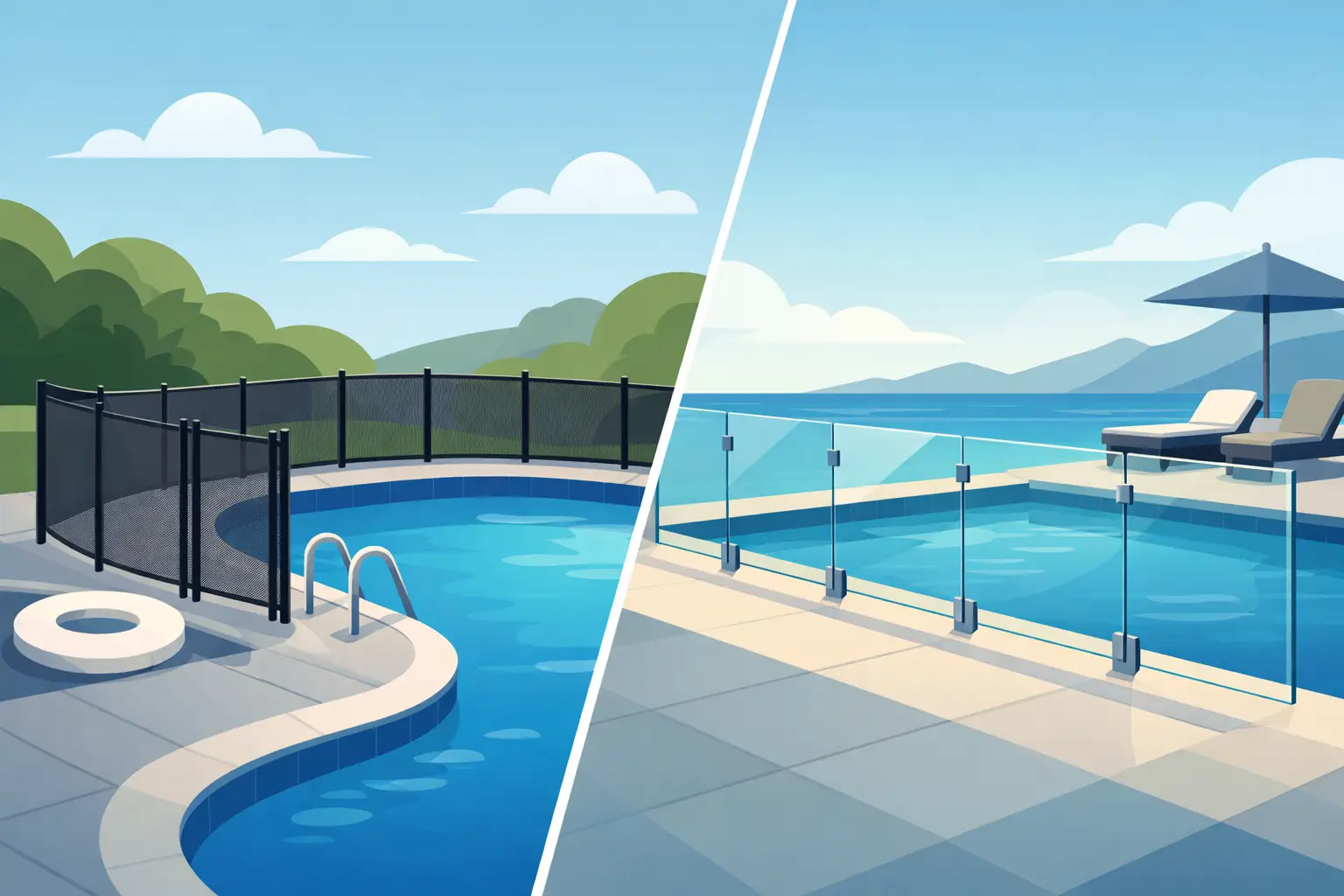

A permanent pool fence solves one problem and creates another. It protects the water, but it also cuts through sightlines, hardens the landscape, and asks architecture to work around a barrier that never leaves. That is why an automatic retractable pool fence cost breakdown matters at the specification stage, not after the pool is finished. For luxury homes, villas, and hospitality settings, price is tied to more than fence length. It reflects engineering, concealment, compliance, controls, and how cleanly the system disappears when protection is not needed.
What an automatic retractable pool fence cost breakdown actually includes
This category is not priced like a standard removable mesh fence or a simple gate package. An automatic retractable system is a built-in architectural safety system. It rises from a concealed below-ground housing, forms a physical barrier around the pool, and retracts fully out of sight when deactivated. That changes the cost structure.
In practical terms, the budget usually includes design review, custom layout planning, below-ground housing and drainage considerations, the fence mechanism, control hardware, power connection, installation, calibration, testing, and handover documentation. If the pool geometry is irregular, the system also needs more customization than a straight run along a rectangular deck.
For owners and project teams, the key point is simple: the visible fence is only one part of the investment. The concealed infrastructure is often what separates a premium integrated system from a surface-mounted product.
Core cost drivers for automatic retractable pool fence systems
Pool perimeter and layout complexity
Perimeter length is the first pricing variable, but not the only one. A long, straight edge is typically more efficient to engineer and install than a freeform pool with curves, steps, water features, tight landscape transitions, or multiple access points.
Every deviation in geometry affects modular planning. More corners, more transitions, and more tailored sections generally increase both fabrication and installation time. If the fence must follow a highly specific architectural line while preserving decking materials and drainage performance, that precision has a cost.
Concealed below-ground construction
This is where many budgets shift. A retractable system requires space below the finished surface for housing, mechanics, and controlled movement. If the system is specified early in a new build, coordination is cleaner and often more cost-efficient. If it is added later, demolition, deck modification, and utility relocation can push costs higher.
Site conditions matter here. Concrete thickness, subsurface conditions, drainage strategy, waterproofing details, and proximity to existing structures all influence installation difficulty. A straightforward new-construction slab is different from cutting into finished stone around a completed pool.
Automation and control package
Automatic operation is a premium feature, but it is also part of the product’s value. Secure remote activation and app-based control require integrated electronics, motorization, safety logic, and commissioning. The system must operate predictably in an outdoor environment exposed to sun, moisture, debris, and repeated use.
Higher-spec control packages may add cost, especially where clients want multiple user permissions, integration planning, or tailored operational settings. For hospitality projects, controlled access and staff operation protocols may also shape the final specification.
Compliance and documentation
Not every fence system is evaluated the same way by project teams, inspectors, or risk managers. When a product is being considered for a high-end residence or guest-facing property, documentation carries weight. Testing, formal handover, and compliance-oriented review are part of the real cost picture.
This does not always show up as a separate line item labeled compliance, but it is built into engineered products and professional installation. For developers, architects, and hotel operators, that discipline often justifies the premium.
Typical budget ranges and why they vary
A true automatic retractable pool fence sits in the premium end of the market. In most cases, buyers should expect pricing far above conventional removable fencing because the system combines structural integration, automation, custom fabrication, and project-specific installation.
For a smaller residential pool with favorable site conditions and a relatively simple layout, costs may begin in the low five figures. For larger pools, complex geometries, retrofit conditions, or hospitality-grade installations, pricing can move significantly higher. In many luxury applications, the final investment lands somewhere in the mid to upper five figures and can exceed that when site work is extensive.
That range is wide for a reason. A system installed during new construction with coordinated concrete, electrical, and drainage planning is a different exercise than retrofitting a finished outdoor space with premium stone, mature landscaping, and limited access for equipment. The fence itself may be similar. The project is not.
Installation costs are often underestimated
New build versus retrofit
If you are comparing proposals, installation scope deserves close attention. In a new build, the housing can be planned into the deck assembly, power can be routed in advance, and adjacent trades can coordinate tolerances. This usually creates the cleanest result and a more controlled budget.
A retrofit is often more expensive because hidden conditions emerge quickly. Existing finishes may need to be cut and repaired. Drainage may need to be reworked. Power may be farther away than expected. A clean design outcome is still achievable, but the path is less direct.
Surface finishes and restoration
High-end projects rarely use basic finishes around the pool. They use large-format stone, custom tile, hardwood decking, or detailed coping conditions. When those surfaces must be opened and restored around a concealed system, labor and material costs rise.
This is one reason low initial estimates can be misleading. The system price and the finished architectural result are connected. If the goal is Invisible Design, restoration quality cannot be treated as an afterthought.
Ongoing costs after installation
An automatic retractable pool fence is not a high-maintenance product, but it is still a mechanical and electrical system in an exposed environment. Owners should budget for periodic inspection, cleaning of tracks or concealed components as specified, software or control updates where applicable, and service checks to confirm reliable operation.
Long-term costs are usually modest compared with the initial installation, but they should be expected. Preventive service is especially important in coastal climates, high-usage hospitality settings, or properties with significant wind, debris, or chemical exposure.
The larger financial point is this: ongoing maintenance helps protect both safety performance and visual precision. A premium system should continue to operate with the same control and finish quality it had at handover.
Where the value is – and where it is not
What you are paying for
The premium is not just automation. It is the combination of concealed integration, physical protection, regulated operation, custom geometry, and a clean landscape when the barrier is down. For many homeowners, that means preserving open views and architectural intent without accepting an always-visible fence. For hospitality operators, it means reducing visual clutter while maintaining a controlled barrier strategy for guest safety.
This is also why simple price-per-foot comparisons can miss the point. Two systems may appear to serve the same purpose, but one behaves like site furniture and the other behaves like infrastructure.
When it may not be the right fit
There are projects where a conventional pool fence is the more rational choice. If budget is the primary driver, if the site cannot support concealed installation without major reconstruction, or if the design does not require visual disappearance, a simpler system may be better aligned.
That is not a weakness in the category. It is just a matter of fit. Automatic retractable fencing is best suited to projects where aesthetics, compliance readiness, and daily convenience are all non-negotiable.
How to evaluate quotes intelligently
A serious proposal should define more than product supply. It should clarify what is included in site review, civil or deck preparation assumptions, power requirements, drainage coordination, installation scope, calibration, testing, and documentation. If those elements are vague, the final cost can move later.
It is also worth asking whether the quote reflects new construction or retrofit conditions, how pool geometry affects customization, and what restoration assumptions are built into the number. A lower proposal can simply mean more exclusions.
For architects and developers, early coordination usually produces the best outcome. For homeowners, the best move is to discuss the system before hardscape is finalized, not after the landscape is complete. That single timing decision can affect both budget and finish quality.
A premium system needs a project-based lens
The most accurate automatic retractable pool fence cost breakdown is never a generic online number. It is a project-based assessment shaped by perimeter, geometry, construction stage, concealment requirements, controls, and compliance expectations. That is especially true in luxury environments where the fence must protect without visually dominating the space.
Smart Fence approaches this as an engineered architectural system, not a commodity barrier. That difference matters in pricing, but it matters even more in the result. When the barrier rises cleanly, operates securely, and disappears completely back into the landscape, the cost is easier to understand. It is not just paying for a fence. It is paying for protection that respects the design.