Frameless glass is usually chosen for one reason: it disappears. Or at least it tries to. From a distance, it keeps sightlines open and feels lighter than tubular metal or decorative fencing. But once a pool is in daily use, the compromises become harder to ignore. Fingerprints, water spots, hardware, gate closers, panel joints, and permanent visual interruption all start to matter.
That is why many homeowners, architects, and hospitality operators start looking for a frameless glass pool fence alternative. Not because glass looks bad at the specification stage, but because it is still a fixed barrier with real operational costs and real limitations. If the brief calls for certified protection without turning the pool perimeter into a permanent enclosure, the better question is not which fence looks least intrusive. It is whether the fence needs to remain visible at all.
What glass actually costs: the numbers most buyers see too late
Frameless glass pool fencing sits at the premium end of the fence market, and understanding the cost structure explains why so many owners reconsider it before or after installation.
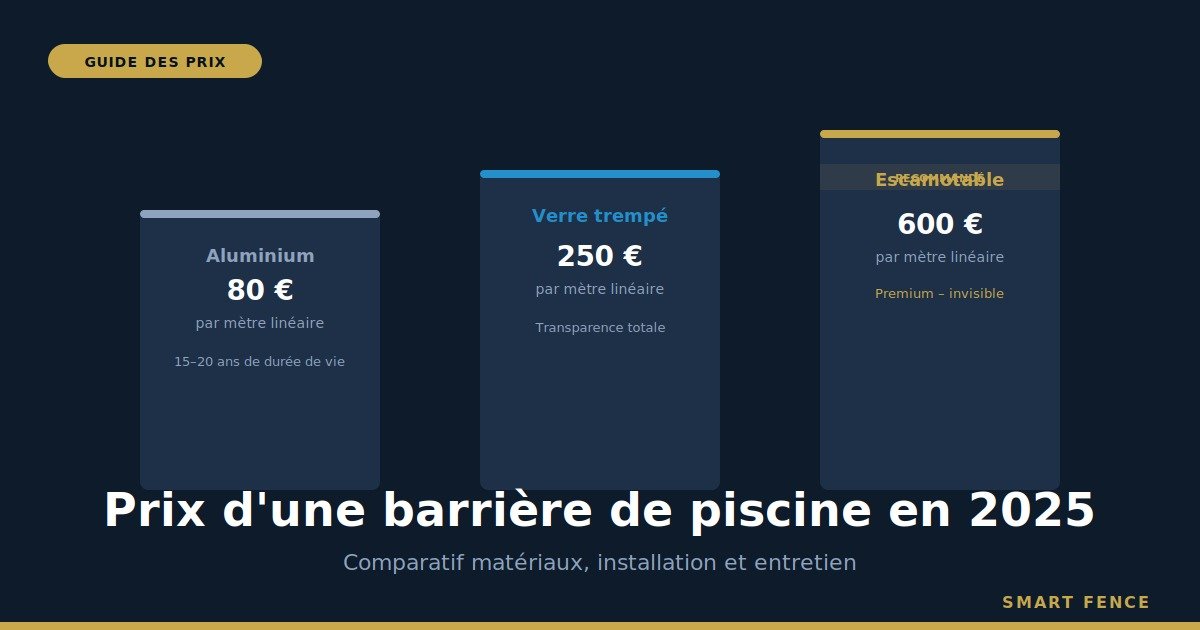
Installed frameless glass typically runs $250 to $500 per linear foot in most US markets. In higher-cost coastal and urban markets, frameless glass at the Los Angeles premium end reaches $353 to $441 per linear foot installed. For a standard residential pool perimeter of forty to fifty linear feet, total installation cost often falls between $12,000 and $25,000, with complex custom pools running significantly higher.
Those are the purchase numbers. The ownership numbers are different. Glass panels that crack or break require professional replacement at $300 to $1,500 or more per panel depending on size, glass specification, and hardware. In coastal environments, stainless steel spigots are vulnerable to a phenomenon known as tea staining: iron deposits from pool chemistry and salt air create rust-colored marks on the hardware, particularly on grade 304 stainless. Remedying this requires either intensive polishing or upgrading to marine-grade 316 stainless, which adds to both the original installation cost and any future service cost. In aggressive coastal environments, even 316 stainless requires periodic attention; the next upgrade is 2205 duplex stainless, a substantially more expensive specification.
Glass panels themselves have a long service life: twenty to thirty years for quality tempered or laminated glass in normal conditions. But the hardware that holds them, including spigots, gate hinges, and self-closing mechanisms, has a shorter reliable lifespan of ten to fifteen years. That asymmetry means a glass fence that looks fine in its seventh year may have gate hardware approaching the end of its reliable service life. A gate that no longer closes consistently or self-latches reliably is not just a maintenance issue. It is a compliance failure.
The specific failure modes buyers discover after installation
The appeal of frameless glass is its transparency. What buyers often discover is that transparency is a condition requiring constant maintenance, not a permanent property of the material.
Pool water carries calcium, chlorine, and mineral compounds that deposit on glass surfaces with every splash cycle. In outdoor pool environments, this process is continuous. A glass panel that is cleaned thoroughly on Monday shows calcium spotting by Thursday. Weekly rinsing is the minimum maintenance standard in any pool environment; professional cleaning with appropriate chemical treatment is typically recommended every six to twelve months to address mineral scale that rinsing does not remove.
In a private residence with attentive upkeep, this can be manageable. In a hospitality setting with high bather load, multiple daily use cycles, and housekeeping priorities that compete for time, glass maintenance is either a constant operational task or a constantly visible problem. A fingerprinted, mineral-stained glass pool fence does not transmit a view. It reflects ambient light, shows every contact point, and reads as an uncleaned surface against an otherwise well-maintained outdoor environment.
Gate hardware introduces a second failure mode that operates independently of appearance. Pool gate self-closing mechanisms and self-latching hardware are mechanical devices operating in a chemically aggressive outdoor environment. They are subject to corrosion, spring tension loss from repeated use, hinge misalignment from thermal expansion, and latch mechanism wear. A gate that fails to self-close or self-latch is the single most common pool barrier compliance deficiency identified at inspections. Unlike a panel with mineral spots, a non-closing gate is not a maintenance issue. It is a safety failure.
What makes a good frameless glass pool fence alternative?
A credible alternative has to do more than look refined. It has to satisfy three requirements simultaneously: physical safety, visual restraint, and practical day-to-day use across the realistic lifespan of the project.
This is where most alternatives fall short of the full brief:
Removable mesh meets the functional requirement and is widely code-approved. Its limitation is visual. Mesh reads as temporary even when installed permanently and rarely belongs in a premium outdoor environment. It is the right answer when budget is the primary constraint. It is not the right answer when design integrity matters.
Aluminum and steel systems are durable and less maintenance-intensive than glass. They add visual mass rather than reducing it. A well-made powder-coated aluminum system can have a service life of thirty-plus years and requires minimal upkeep compared with glass or stainless hardware. But it makes the barrier more visible, not less, and it never disappears.
Landscaping and level changes can support access control in some configurations, but they are not substitutes for a code-compliant barrier and they significantly alter the architecture. These approaches work for specific site conditions and should be evaluated on a project-by-project basis.
A retractable pool safety barrier sits in a different category. It does not ask which permanent material is least disruptive. It removes the barrier from the visual environment entirely when protection is not required.
The leading alternative: retractable below-ground safety fencing
A retractable pool safety system is concealed in a below-ground housing that sits flush with the surrounding deck surface when the fence is not deployed. When activated, it rises to create a compliant physical barrier around the pool perimeter. When the pool is in supervised use or when the outdoor space is being used without pool access risk, the fence retracts and the landscape returns to its intended condition.
That changes the comparison fundamentally. Glass versus retractable is not a comparison between two fence materials. It is a comparison between a permanent perimeter and a conditional one. Glass reduces visual impact compared with opaque fencing. A retractable system eliminates it when reduction is insufficient.
For the homeowner who wants to look from the living room to the pool without a fence line in the frame, retractable is the more complete answer. For the architect who resolved the pool terrace composition around clear sightlines and horizontal continuity, a permanent fence of any material breaks that composition. For the hospitality operator who wants the pool deck to present as an open luxury environment during supervised hours, glass still creates a barrier in every photograph, every event setup, and every guest arrival impression.
The gate behavior of a retractable system also addresses the most common glass failure mode. The gate on a retractable fence closes automatically within a defined time window after use. The mechanism is not a spring-loaded hinge subject to tension loss. It is a controlled motorized function tested at commissioning and documented in the handover record. The gate that self-closes reliably on day one is designed to self-close reliably three years later, because it is not a passive mechanism degrading under repeated use in a pool chemical environment.
When glass is still the right answer
Being fair about this comparison means acknowledging where glass performs well.
For pools where the fence will be permanent, views are secondary to other design priorities, and the owner has the budget and discipline for consistent maintenance, glass is an established and widely approved solution. Local authorities are familiar with it. Installation is straightforward. When budget allows a full frameless glass specification with marine-grade hardware in a non-coastal environment, the result can be excellent for many years.
Glass also suits installations where the architectural language calls for visible glass elements elsewhere: exterior glazing, glass balustrades, or glass-framed outdoor spaces where the pool fence participates in a consistent material vocabulary. In that context, glass is not an afterthought. It is part of the design logic.
The cases where glass consistently disappoints are: coastal and salt-air environments where hardware corrosion is accelerated, high-use hospitality environments where maintenance cannot match the pace of buildup, pools positioned in front of significant views where any permanent perimeter reads as an interruption, and custom pool geometries where standard glass panel widths force awkward approximations around curves.
Design integration: where the comparison resolves itself
When people search for a frameless glass pool fence alternative, they often compare materials: transparency, color, profile. That is a useful start but an incomplete frame.
In premium environments, the better question is integration. Does the system respect the geometry of the pool rather than forcing the pool edge into standard dimensions? Does it preserve paving continuity, planting composition, and key views? Does it feel designed into the project or added after the fact?
A below-ground retractable system has a clear advantage in integration because it can be configured to the exact pool perimeter rather than being cut to panel sizes. The housing top rail accepts a finish layer in the surrounding tile or deck material, which means the fence path is invisible in the floor pattern when the fence is retracted. The deployment geometry follows the pool edge closely regardless of shape. The gate unit sits where access logic requires it, not where a standard panel arrangement makes it convenient.
For architects, this means the safety system can be treated as an engineered element rather than a visible product. For property owners, it means the pool area functions as intended when protection is not required and performs as required when it is.
Compliance is non-negotiable regardless of material choice
Any alternative to glass must be evaluated against applicable pool barrier requirements. Height, climb resistance, gate function, ground clearance, and latch placement are consistent requirements across jurisdictions regardless of which system is selected.
For a retractable system specifically, the compliance question focuses on performance in the deployed state: does the barrier reach the required height, do the gaps between elements satisfy the sphere rule, does the gate self-close and self-latch, and is the system documented with commissioning records and handover materials that support regulatory review?
These are the right questions to ask of any system at specification. A beautifully minimal concept that does not produce clear answers to those questions is a risk, not a solution.
For hospitality and shared-use properties where liability exposure is elevated, documentation quality matters as much as system performance. The difference between an engineered system with a formal commissioning record and a product that was simply installed is significant when an incident prompts review of what protective measures were in place and whether they were maintained to standard.
Who should consider this alternative?
The buyers who find a retractable system more compelling than fixed glass are typically those for whom the permanent nature of the glass fence is the primary problem, not the glass itself.
If the pool sits in front of a significant view, if the pool area serves as an event and entertaining space, if the property hosts rotating guests who are unfamiliar with the site, or if the architectural brief prioritizes spatial openness over material minimalism, the retractable system offers what glass cannot: certified protection that is genuinely absent when it is not needed.
For design professionals who want to preserve the cleanest possible reading of an outdoor composition, and for property owners who want the pool to feel open during the majority of their use and controlled during the minority where risk is elevated, the retractable system solves the problem that glass only reduces.
Smart Fence is designed for exactly that brief: below-ground housing flush with the surrounding finish, automatic gate closure within 20 seconds of use, LED perimeter lighting that signals system state, and formal documentation at handover. The best alternative to frameless glass is not a different material. It is a system that makes the barrier conditional rather than constant.