Choosing an automatic pool safety fence in a premium context is not a product decision. It is a specification decision. The system needs to protect people reliably, align with the regulatory framework that governs the project’s location, integrate with how the property is actually operated, and preserve the architecture that makes the space valuable in the first place.
Those four requirements exist in every market where automatic pool fencing is specified: Sydney, Dubai, Cape Town, the French Riviera, Bali, Singapore, London. The framework for evaluating any system against them is the same. What changes is the specific regulatory standard and the material specification appropriate for the local environment.
The three-filter framework
The most reliable way to evaluate an automatic pool fence is to work through three sequential filters. Each narrows the field based on project-critical requirements, rather than aesthetic preference or marketing claims.
Filter 1: Compliance. Does the system, when deployed, meet the applicable standard for the project’s jurisdiction? This is not a global answer. It requires confirming what standard applies and whether the system satisfies it in its deployed state.
Filter 2: Integration. Does the system fit into how the property operates, both physically and in terms of control and smart home connectivity?
Filter 3: Operation. Will the system be used correctly, every time, under real-world conditions with real staff or real family members?
A system that fails any of these filters will eventually fail as a safety solution, regardless of how sophisticated it appears in a product demonstration.
Filter 1: Compliance varies by country and must be confirmed at the project level
The most consequential mistake in specifying a pool safety fence is assuming that a product approved or commonly used in one country automatically satisfies requirements in another.
Australia and New Zealand (AS 1926.1): The standard requires a permanent four-sided isolation barrier with 1.2-metre minimum height, maximum 100mm gap, a 900mm non-climbable zone, and self-closing self-latching gate with child-resistant release. The “permanent structure” requirement means that retractable systems require pre-submission discussion with the local council and a licensed pool safety inspector before specification is finalized. This is the most complex compliance conversation for automatic retractable systems globally.
France (NF P90-306): The Raffarin Law permits physical barriers, alarms, covers, or enclosures. For physical barriers, the requirement is 1.1-metre minimum height, self-closing self-locking gate, and 1-metre minimum setback from the pool edge. Removable and permanent barriers are both accepted, giving retractable systems a clear compliance path under French law.
South Africa (SANS 1390): 1.2-metre minimum height, no openings permitting a 100mm ball, no footholds, self-closing self-latching gate with 1.5-metre minimum latch height. Performance-based standard without a permanence requirement, giving retractable systems a viable compliance path.
UAE/Dubai (Dubai Municipality): 1.2-metre minimum height from finished floor level, self-closing gate with locking device, gate opening away from pool. Performance-based evaluation framework.
United States (ISPSC with state amendments): 48-inch minimum height nationally, 60 inches in California and Arizona. 4-inch sphere rule for gaps. 54-inch minimum latch height. Self-closing, self-latching gate swinging outward. Jurisdiction-specific compliance path for retractable systems through the AHJ.
United Kingdom: No mandatory national standard for private residential pools. Professional duty of care standard requires designing to a recognized benchmark such as AS 1926.1 or ISPSC. Insurer requirements increasingly specify compliance with international standards.
Singapore, Thailand, Bali/Indonesia: No mandatory national residential pool fence standards comparable to Australia or France. International buyers and operators increasingly specify to AS 1926.1 or ISPSC as a voluntary benchmark, driven by insurer requirements, platform requirements, and professional liability awareness.
The compliance question for any automatic system is always project-level: which standard governs this property, in this jurisdiction, for this use type (residential, rental, hospitality)? Confirming this before specification prevents the most expensive compliance errors.
What to verify during the compliance evaluation
Regardless of market, these questions confirm whether a specific system meets the applicable standard:
Does the deployed barrier reach the required minimum height from the exterior grade at every point along the perimeter? Are all gaps in the deployed barrier within the applicable maximum (100mm / 4 inches)? Does the gate close automatically from any open position without assistance? Does the gate latch engage without manual assistance? Is the latch release positioned to prevent child operation from the exterior? Are the barrier surface and gate free from horizontal elements that create footholds within the non-climbable zone?
A system that cannot be documented as meeting these criteria in the deployed condition is not a compliant system, regardless of what the manufacturer claims.
Filter 2: Integration into the property’s physical and operational environment
The second filter addresses how the system fits into the specific project, not just whether it can be made to work.
Geometry fit. Automatic retractable systems are only as good as their modularity allows. A system configured in standard-length sections that cannot accommodate irregular pool geometry forces compromise: gaps in coverage, housing units that don’t follow the pool edge, or sections that require bespoke workarounds. The system should be configurable to the exact pool perimeter, including curves, corners, and access point positions that reflect the design logic of the outdoor space.
Civil and services integration. A below-grade retractable system requires trench preparation, concrete housing beds, drainage from each unit, and power supply to the controller. These are coordinated civil and services works that must happen in sequence with the surrounding hardscape, electrical planning, and drainage layout. In new construction, this coordination is straightforward. In retrofit situations, the system needs to work within the constraints of existing infrastructure without creating drainage failures or electrical complications.
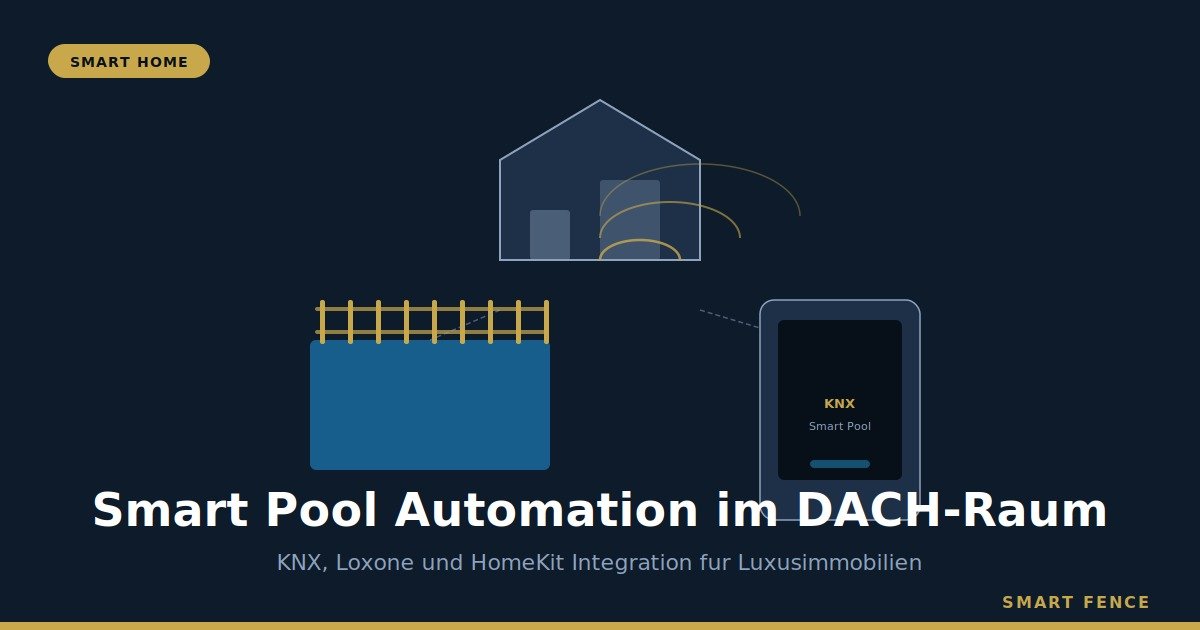
Smart home integration. The property’s automation platform determines how the fence participates in the broader control system. In markets where KNX dominates (Germany, Austria, Switzerland, Benelux), the fence’s dry contact outputs must be configured for KNX integration. In Australian properties using C-Bus, in Gulf villas using Crestron or Control4, and in US luxury residential projects using Savant or Lutron, the protocol-agnostic nature of dry contact outputs is the integration feature that matters. Any system that requires a proprietary bridge to connect to the home automation platform introduces a single point of failure and a proprietary dependency.
Material specification for the deployment environment. An automatic fence that performs correctly for the first two years and then develops operational failures due to corrosion or UV degradation has failed. Material specification must account for the specific exposure conditions of the project:
In coastal Gulf environments (UAE, Qatar, Saudi Arabia): marine-grade 316 stainless minimum for all hardware, SRPC concrete for housing beds in saline groundwater conditions, UV-stabilized polymer components for surface temperatures exceeding 70°C.
In coastal Australian and South African environments: marine-grade 316 stainless, UV-stabilized polymers at Australian solar radiation levels, corrosion-resistant coating specifications for hardware in salt spray zones.
In Southeast Asian tropical environments (Bali, Phuket, Singapore): high humidity and tropical rainfall require polymer components with full corrosion resistance, housing drainage sized for tropical rainfall rates, cable management designed for high ambient moisture.
In Mediterranean European environments (France, Italy, Spain, Greece): limestone soil drainage is generally favourable, moderate UV, 316 stainless for coastal installations, 304 acceptable for inland projects with low salt exposure.
Filter 3: Operation under real-world conditions
A specification that passes filters 1 and 2 can still fail in use if the system depends on behavioral discipline that real-world users do not consistently apply.
This is where automatic pool fences are categorically different from manual alternatives in every market. The gate that closes automatically within a defined time window regardless of what the last person through did eliminates the most common failure mode in pool barrier management globally. The gate that requires someone to wait for it to swing shut and manually confirm the latch has engaged is the gate that gets left open.
For properties with young children, the behavioral case for automatic closure is straightforward. For hospitality properties and rental environments in any market, the case is even stronger: staff and guests cannot be relied upon to consistently follow a gate discipline protocol across shift changes, guest turnovers, and maintenance visits.
The specific operational questions to verify:
Does the gate close from any open position, including barely cracked? The system should close reliably from a 5-degree opening as well as from a 90-degree swing.
Does the gate closure mechanism depend on spring tension, or is it motorized? Spring tension degrades under repeated use and pool chemical exposure in every climate. Motorized closure is a calibrated, tested function verified at commissioning.
Is the gate auto-close timing appropriate for the property’s use pattern? A 20-second window is standard. In high-traffic hospitality environments, the timing should be confirmed as appropriate for the operational context.
Can the system state be verified remotely? For second homes, rental properties, and managed hospitality in any market, the ability to confirm barrier state without physical presence is an operational requirement, not a luxury.
Can authorized users be differentiated? In an estate management context, the owner, household manager, and maintenance staff should have different access profiles. In a hospitality context, operational staff, management, and guests should have differentiated access levels.
Red flags that apply in every market
These warning signs apply regardless of which country the project is in or which regulatory standard governs.
A supplier who cannot provide dimensional verification data for the deployed barrier state is selling an unverified product. In any market, the compliance evidence is the installed condition, not the product specification sheet.
A system whose gate mechanism relies entirely on passive spring tension is a system that will fail progressively over outdoor service cycles. The service life and tension degradation curve should be documented.
An installation team that cannot explain how drainage from each below-grade housing unit is managed is an installation team that will create long-term operational failures. Drainage is not optional in any climate.
Documentation that consists only of product literature is not documentation. The compliance-ready deliverable is an as-built drawing, calibration records, gate timing verification, and operating instructions in the relevant language.
A supplier who becomes defensive when asked about pre-submittal regulatory engagement is a supplier who has not navigated the compliance path in your specific market. Ask directly: have you installed this system in this jurisdiction, and what did the compliance process involve?
What good evaluation looks like in practice
The evaluation process for an automatic pool safety fence in any market follows the same sequence. Confirm the applicable regulatory standard and any specific jurisdiction requirements. Request deployed-state dimensional data that can be verified against that standard. Confirm material specification for the project’s specific environmental exposure. Review the integration with the property’s civil, electrical, and home automation systems. Confirm commissioning and testing protocols and what documentation will be produced at handover.
For architect-led projects, that evaluation should happen at schematic design, not at tender. For hospitality operators, the compliance and operational documentation requirements should be part of the vendor brief from the start.
Smart Fence approaches this evaluation process with project-based delivery in every market: below-ground housing flush with the surrounding finish, deployed-state dimensional verification, motorized gate closure within 20 seconds of use, LED perimeter lighting confirming system state, dry contact outputs for smart home integration in any protocol, and formal handover documentation structured for the compliance requirements of the applicable jurisdiction, whether that is AS 1926.1, NF P90-306, SANS 1390, ISPSC, or Dubai Municipality guidelines.
The right automatic pool safety fence is the one that passes all three filters: compliant in its deployed state for the specific project jurisdiction, integrated into the property’s physical and operational environment, and operated through mechanisms that do not depend on behavioral consistency that real-world conditions cannot guarantee. That combination is available. It requires specification discipline to find it.