A pool can look perfectly calm and still present a serious access risk. That is why the choice between a pool safety cover vs retractable fence is not just about product preference. It is a decision about how you want protection to function in real life: day to day, season to season, and under the standards your property is expected to meet.
For luxury homes, boutique hospitality settings, and architect-led outdoor spaces, the comparison usually comes down to one core question: do you want to secure the water surface itself, or control access to the pool area? Both approaches can play a role in pool safety. They do not solve the same problem in the same way.
What each system actually does
A pool safety cover spans across the pool basin. When fully closed, it creates a barrier over the water. Depending on the system, it may be manual, semi-automatic, or motorized, and it typically anchors at the pool edge or within a track system built into the coping or deck.
A retractable fence creates a physical perimeter barrier around the pool. It is designed to prevent unsupervised entry into the pool zone before someone reaches the water. In a fully automatic system, the barrier rises when needed and disappears below ground when not, preserving sightlines and outdoor design.
That distinction matters more than it might appear. A cover protects the opening of the pool. A fence protects the approach to the pool. Those are two different moments in the sequence that leads to a drowning incident, and they are controlled by two different types of system.
What safety covers are actually certified to do
The standard that governs pool safety cover performance in the US is ASTM F1346. When correctly installed and used in accordance with the manufacturer’s instructions, ASTM F1346 is intended to reduce the risk of drowning by inhibiting the access of children under five years of age to the water.
The standard specifies four performance tests. The static load test requires the cover to support a weight of at least 485 pounds, representing the estimated average weight of two adults and one child, to permit rescue operations. The perimeter deflection test demonstrates that any opening between the cover and the pool edge is too small for a child to pass through. The surface drainage test ensures that a dangerous amount of water cannot accumulate on the cover’s surface. The openings test confirms that any openings remain small enough to prevent a small child’s head from gaining access to the water.
These are meaningful requirements. A cover meeting ASTM F1346 is a genuine engineering specification, not a marketing claim. But the standard’s own language is instructive: it inhibits access, it does not eliminate risk, and it only functions when correctly installed and used as instructed. That last clause carries significant operational weight.
The safety risks that covers introduce
A safety cover is often assumed to be a passive protection that simply stays in place. The reality is more conditional. Pool covers can create a false sense of security, and this complacency is especially dangerous when it comes to children and pets.
There are three specific failure modes worth understanding.
Water accumulation on solid covers. A solid vinyl cover, while impermeable, will collect rainwater. Even a few inches of water on top of a cover can be enough for a small child to drown in. The ASTM surface drainage test addresses this for compliant covers, but it represents a real condition that non-compliant or deteriorating covers can create.
The false solid problem. A taut cover can appear to be a solid surface to a running child or a playful dog. If the cover sags under their weight, they can be drawn toward the center, creating a bowl of water and a serious entrapment situation. A child who steps onto what appears to be a stable surface and finds it yielding under them cannot reliably self-rescue. This is the scenario ASTM’s perimeter deflection and static load tests are designed to limit, but only for covers that meet the standard and are correctly installed.
Installation gaps. A 2025 CPSC recall involved approximately 11,500 pool covers that could leave a gap of more than 4.5 inches between the cover roller and the pool surface when installed incorrectly, posing drowning and entrapment hazards to children. The recall required owners to keep children away from the pool cover at all times until repaired. This illustrates that installation quality is not a secondary concern with covers: a gap at the roller end creates exactly the access point the cover is supposed to eliminate.
The “open for use” gap. The failure mode that receives the least attention is not product failure but normal operation. A cover only protects when it is completely closed. The moment the pool is uncovered for swimming, maintenance, cleaning, or any other reason, the protection is entirely removed. During exactly the moments when adults may be most distracted, the cover is open because someone has decided to use or service the pool.
Pool safety cover vs retractable fence: which option is better for child safety?
If the goal is to reduce the chance of a child entering the pool area unsupervised, a compliant fence offers a more direct line of protection. Among the access pathway vulnerabilities that contribute to child pool drownings are partially secure pool covers, alongside gates left propped open and climbable fencing. A fence that controls access before a child reaches the water addresses the risk at an earlier point in the sequence.
The critical temporal distinction is this: a fence stops a toddler at the perimeter of the pool zone. A cover only protects once that child has already reached the pool edge. Given that a drowning timeline for a toddler can progress from submersion to airway compromise within 20 to 30 seconds, preventing the approach entirely is meaningfully stronger than relying on a surface barrier the child must reach before any protection activates.
A retractable fence also preserves its protection regardless of whether the pool is in active use, open for maintenance, or being serviced. A cover cannot offer that.
Compliance is rarely one-size-fits-all
When clients compare pool safety cover vs retractable fence, they often assume either product can satisfy the same regulatory requirement. That is not always the case.
Pool barrier codes in the US are typically centered on restricting direct access to the water through a physical enclosure with defined height, gate, latch, and climb-resistance criteria. A cover may contribute to a broader safety strategy, but it is not automatically treated as a substitute for a code-compliant perimeter barrier in every jurisdiction. Some states and municipalities specifically permit an ASTM F1346-compliant cover as an alternative to one layer of a multi-layer barrier. Others require a fence regardless of cover status. Local review is essential before assuming one system substitutes for the other.
A retractable fence has a practical compliance advantage because it is built around the logic most regulations already recognize: controlled access through a physical perimeter barrier with defined dimensional and operational requirements. That does not remove the need for local review, but it aligns more naturally with how code officials evaluate pool safety submissions.
Cost context: what each system actually costs
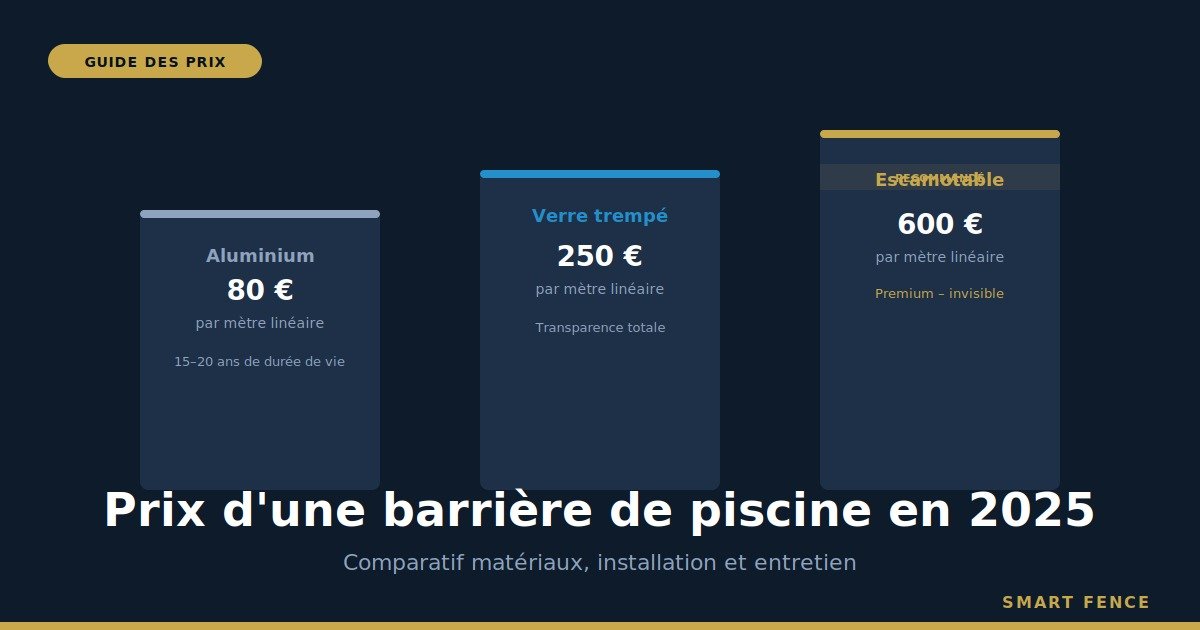
A solid pool safety cover costs $1,500 to $3,600 installed. An automatic pool cover costs $8,000 to $20,000 with installation, including the cover material, track system, motor, control panel, and professional installation. Premium custom automatic covers in 2026 typically start around $15,000 to $25,000 for many projects, with premium custom builds reaching $30,000.
Ongoing costs are also real. Annual professional servicing for an automatic cover runs $200 to $500. Replacement components including motors at $800 to $2,000, tracks at $500 to $1,500, and fabric at $1,000 to $3,000 can increase total ownership cost significantly.
Covers also have a track record of motor and mechanism wear. Automated covers rely on motors, tracks, and electricity. A power outage, a jammed track, or a forgotten command to close the cover leaves the pool dangerously exposed.
Design impact is where the comparison gets sharper
Many premium properties reject traditional pool fencing because it stays in view at all times. That concern often pushes owners toward covers. But covers change the visual character of the pool itself. When closed, a safety cover visually dominates the water plane and the pool edge. When open, the track system, roller housing, and cover storage are still present and need to be accommodated within the project. On a luxury pool designed for architectural impact, that hardware is part of every view.
A retractable fence approaches aesthetics differently. Instead of occupying the water plane, it protects the perimeter only when needed. In a concealed below-ground system, the barrier disappears fully when retracted, leaving the architecture, landscaping, and sightlines intact. The pool reads exactly as designed. For high-end residences and hospitality environments, that can be the cleaner design answer: open and uncompromised when in use and supervised, physically protected when not.
Operation affects safety more than most buyers expect
A product can be technically strong and still fail in practice if it is inconvenient to use. That is where operation deserves close attention.
Safety covers ask the owner or operator to close the pool surface every time protection is needed, and to reopen it correctly every time access is wanted. In hospitality settings where staff consistency matters, or in family homes where the pool transitions between supervised and unsupervised conditions multiple times per day, that sequence creates operational pressure. The evidence from real-world pool safety data is that operational friction is consistently where safety gaps appear.
A retractable fence reduces that friction. With automatic activation via secure remote, app, or smart home integration, the barrier deploys without physically handling hardware. The gate closes automatically within a defined time window after use, removing the most common failure point in pool barrier management: forgetting to close it after passing through. That is not a luxury feature. It is a reliable operational behavior that supports consistent safety discipline.
Maintenance and long-term performance
Both systems live in demanding conditions. The comparison is not between a high-maintenance and low-maintenance option. It is between different types of wear in different locations.
A cover’s fabric, tracks, motor, and anchoring points are all subject to UV exposure, chemical contact, temperature cycling, and mechanical stress. The track system that holds the cover in place and the perimeter sealing between the cover and pool edge are the components where failure creates safety consequences rather than just inconvenience. Fabric replacement costs start around $2,500, and motor servicing is a recurring annual item.
A retractable fence distributes its wear across the housing units, cable runs, drive components, drainage outlets, and gate mechanism. A well-engineered system with proper commissioning and periodic service maintains its performance over its designed lifespan. The gate’s automatic closing behavior should be tested periodically to confirm it remains within its intended time window, and drainage from the housing units should be kept clear.
For architects and developers, the practical difference is this: a cover’s maintenance points are visible at the pool surface, while a retractable fence’s service requirements are below grade and at the gate mechanism. Neither is set and forget, but the retractable fence maintains the visual quality of the outdoor space throughout its service life in a way that a cover cannot.
When a pool safety cover makes sense
A safety cover is a strong choice when the primary goal is securing the pool vessel during extended periods of non-use, reducing debris accumulation, managing water temperature, or reducing evaporation and chemical consumption. It also appeals to owners who want a single product to serve both closure and safety functions during off-season or low-use periods.
In those scenarios, the cover is doing what it is designed to do. That is valuable. It simply should not be confused with perimeter access control, and it should not be assumed to substitute for a fence in jurisdictions that require both.
For some projects, a cover may complement other safety measures rather than replace them. That depends on site layout, local regulation, and how the pool is used day to day.
When a retractable fence is the stronger solution
A retractable fence is the better fit when preventing unsupervised access is the primary safety goal, when visual quality must be maintained, and when operational reliability is more important than any single closure product.
That is especially true for family homes with young children, private villas with open garden layouts, and hospitality properties where guest movement must be managed without making the pool area feel enclosed or institutional. It also fits projects where the pool transitions between active use and unattended states multiple times per day, which is exactly when operational simplicity has the most safety value.
Smart Fence provides that: below-ground housing that sits flush with the surrounding finish surface, modular geometry configured to the exact pool perimeter, a gate that closes automatically within 20 seconds of use, perimeter LED lighting that signals system state, and documented handover that supports compliance review. When protection is needed, it is there. When the pool is open and supervised, the landscape is intact.
The better question is not which product is safer
It is tempting to ask which option wins outright. In reality, pool safety cover vs retractable fence is not a simple contest because the two systems protect in different ways, at different points in the access sequence, with different operational profiles.
If you want to close the pool vessel during off-season or extended non-use, a cover may fit that brief. If you want to prevent entry to the pool area on demand, day in and day out, in a property where design integrity matters, a retractable fence is the more direct solution. If you need a barrier that supports compliance logic, preserves architectural openness, and can be activated reliably every time the pool is unattended, the fence becomes the stronger answer by a meaningful margin.
The best pool safety decisions are made before installation, not after an incident or a failed inspection. Start with the risk you actually need to control, then choose the system that handles that risk without asking your design to absorb the compromise.