A swimming pool barrier is only as safe as its worst moment
A swimming pool barrier is only as safe as its worst moment. Not its best moment. Not its average moment. The single worst moment in an ordinary week, when someone is distracted, in a hurry, or simply forgot.
That is the right lens for evaluating any pool fence. Not how it performs when everyone is paying attention, but how it performs when nobody is.
What the research actually says about pool fence effectiveness
The evidence base for physical pool barriers is among the strongest in any child safety intervention. A Cochrane meta-analysis, the highest standard of evidence synthesis in clinical and public health research, found that four-sided pool isolation fencing produces an odds ratio of 0.27 for drowning compared with unfenced or three-sided barrier configurations. This translates to a drowning risk reduction of over 73 percent.
The AAP policy statement on drowning prevention, most recently reaffirmed in December 2024, identifies four-sided isolation fencing as the single most effective drowning prevention intervention available for residential pools. This is the global scientific consensus, consistent across Australian, US, European, and WHO research bodies.
What the research also consistently finds is that the barrier’s effectiveness is critically dependent on whether it is in its protective state at the time a child accesses the pool area. Sixty-nine percent of child drownings occur during non-swim time, when the child was not expected to be near the pool. These are exactly the moments when a fence should be deployed and is most likely, in a traditional system, not to be.
The gap between a barrier’s theoretical effectiveness when correctly used and its real-world effectiveness as actually used is the safety gap this comparison is designed to illuminate.
The failure modes of traditional fencing: specific and documented
Traditional pool fences fail in three distinct categories, each with its own mechanism.
Removable mesh: the installation failure. Removable mesh fencing is effective when installed correctly and completely. The problem is the “when.” Removable mesh requires physical assembly: posts are inserted into deck sleeves, mesh panels are tensioned between posts, and the gate is latched in position. This process takes several minutes and requires the full set of components to be available, undamaged, and correctly installed.
Real-world use creates consistent deviation from this standard. After a swimming session when children are tired and adults are managing towels, food, and the transition back inside, mesh reinstallation is delayed. After an outdoor gathering where the fence was removed to create circulation space, it is not always replaced immediately. A fence that is in storage rather than deployed provides zero protection.
Permanent fixed fencing: the gate failure. A permanently installed fence eliminates the installation problem but concentrates safety performance entirely in the gate. The gate must self-close from every open position, engage the latch reliably, and do so across years of outdoor exposure, temperature cycling, chemical splash, and high-use conditions.
Gate hardware failure is the leading cause of pool barrier non-compliance across every jurisdiction that inspects regularly. Self-closing spring hinges lose tension. Self-latching mechanisms drift as posts shift and gate frames settle. In hospitality environments, gates cycle hundreds of times per day under conditions that accelerate wear. The gate that passed inspection at installation may not be performing to standard eighteen months later, and without scheduled inspection, that degradation is invisible until it matters.
All manual systems: the behavioral failure. The deepest failure mode of any manual system is human behaviour under normal conditions. The CPSC research on alarm response times shows a window of 7 to 30 seconds between a child accessing water and an adult responding. The WHO data shows drowning can begin in as few as 25 seconds. The behavioural gap is not a function of carelessness; it is a function of the unpredictable timing of supervision lapses in ordinary domestic and commercial settings.
Any barrier that depends on a human closing it, latching it, or reinstalling it at the right moment is a barrier that performs perfectly except when it matters most.
What makes a pool fence “smart”: the actual features
The term “smart” in pool fencing can mean different things. For the purpose of this comparison, a smart pool fence is one that eliminates the three failure modes described above through engineering rather than requiring behavioral compliance.
Automatic deployment and retraction. The barrier rises and lowers through controlled operation rather than manual physical work. Deployment is a single action on a remote or smartphone, not a multi-step physical task. This eliminates the installation failure mode by making deployment frictionless.
Motorized gate with timed auto-close. The gate closes automatically within a defined time window after use. This is not a spring hinge that depends on tension maintained over years of outdoor exposure. It is a controlled motorized function that closes the gate regardless of whether anyone waits for it. This eliminates the gate failure mode entirely.
State indication. LED perimeter lighting activates when the fence deploys and confirms the barrier is in position. App-based status visibility allows anyone with authorized access to check fence state remotely. The ambiguity about whether the fence is up or not, common in any large property, is replaced by a verifiable status that anyone can confirm.
Smart home integration. Through protocol-agnostic dry contact outputs, the fence state becomes part of the property’s broader automation logic. The pool barrier can be incorporated into departure scenes, overnight routines, and changeover protocols. The barrier deploys as part of how the property manages itself, not as a separate task anyone must remember.
Secured access control. A concealed activation button at adult height, a dedicated remote, and app authentication with device credentials create multiple layers that prevent unauthorized operation. A child cannot lower a deployed fence by pressing something at pool level or by finding a button.
The behavioral science behind “easier = safer”
The argument that smart pool fencing is safer than traditional fencing is grounded not only in the engineering of specific failure modes but in the behavioral science of why safety systems succeed or fail in real environments.
The UK Behavioural Insights Team, working on evidence-based policy since 2010, identified “Make it Easy” as one of the most consistently effective behavioral change interventions available. The principle is that reducing friction, the effort required to perform a desired behavior, increases the frequency with which that behavior occurs. This is not theoretical: it is documented across tax compliance, vaccination uptake, organ donation registration, and energy conservation programs in countries including the UK, Denmark, the US, and Australia.
Applied to pool safety: a barrier that takes seconds to deploy is deployed more consistently than one that takes minutes. A gate that closes automatically is closed more consistently than one that depends on someone waiting for it to swing shut. A system whose status is remotely checkable produces more reliable deployment behavior than one where the only way to know the gate is closed is to walk to the pool.
The traditional fence’s failure is not primarily a product failure. It is a behavioral failure predicted by the same behavioral research that has redesigned everything from pension enrollment to food labeling. The smart fence’s safety advantage is not primarily a technological advantage. It is a behavioral design advantage: it changes the actions required to maintain safety from difficult to trivially easy.
The comparison: what changes between traditional and smart
The core difference is not visibility, though that matters. It is not technology, though that enables it. The core difference is where safety performance is located.
In a traditional fence, safety performance is located in human behavior: someone must install the fence, latch the gate, check it regularly, and maintain the hardware. When human behavior is consistent, the fence works. When human behavior lapses, the fence fails.
In a smart fence, safety performance is located in the mechanism: the barrier deploys through controlled operation, the gate closes through motorized function, the status is verifiable without physical inspection, and the system maintains its state through power rather than through human memory. Human behavior is still required, but the behaviors required are simpler, faster, and verifiable.
This distinction produces different safety performance not because the smart fence is physically stronger or taller, but because it removes the behavioral gap that is responsible for the incidents traditional fences fail to prevent.
Where traditional fencing still performs well
A fair comparison acknowledges where traditional fencing is the right answer.
A permanently installed metal or glass fence that stays in place at all times, with correctly specified gate hardware and a regular maintenance schedule, provides reliable protection in the conditions where it is always deployed. For properties with adult owners and no young children, where the fence is never removed and gates are inspected regularly, a traditional permanent fence performs close to its theoretical maximum.
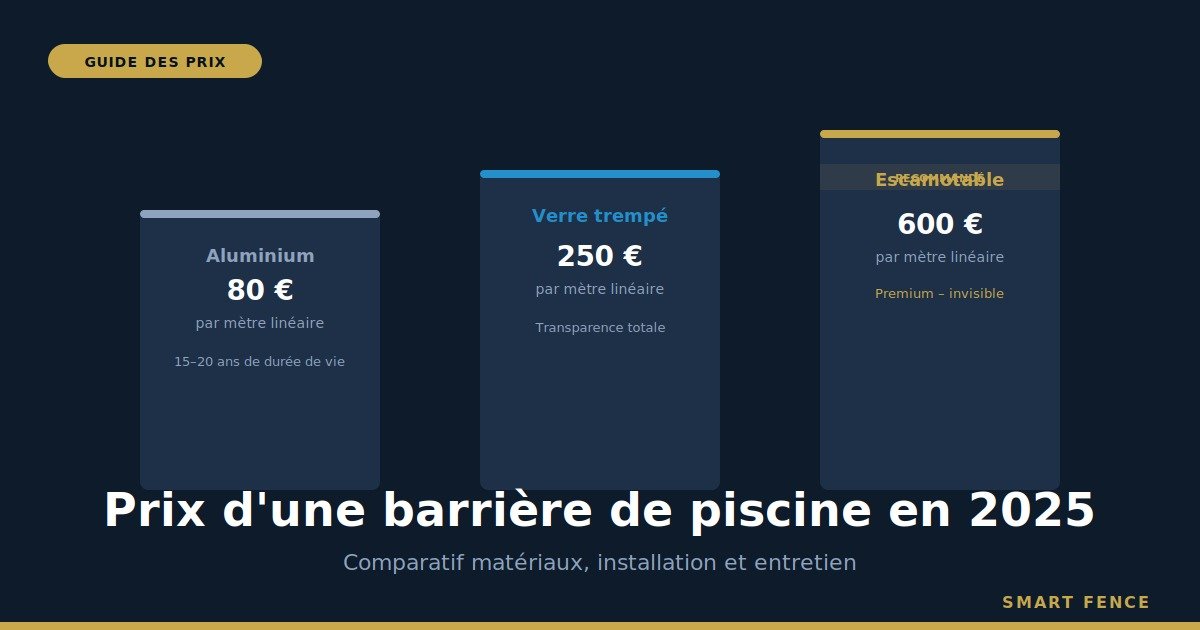
Traditional fencing is also the correct specification for projects where budget is the primary constraint. Removable mesh at $17 to $35 per linear foot or permanent aluminum at $30 to $80 per linear foot are accessible price points. Smart retractable systems require a more significant investment, and that investment is not justified in every context.
Where traditional fencing underperforms its theoretical maximum is exactly where smart systems provide the most additional value: properties with children present regularly, properties with rotating occupants or staff, properties where aesthetic pressure to remove the fence is significant, and hospitality environments where gate discipline across a rotating staff team cannot be guaranteed.
The global regulatory trend: toward reliability, not just presence
Regulatory frameworks for pool barriers in every major market are trending in the same direction: from requiring that a barrier exist to requiring that it function reliably.
Australia’s AS 1926.1 requires barriers to be maintained in good condition at all times, with broken or damaged fences and gates requiring immediate repair. The standard focuses on functional performance, not just installed presence. Queensland requires re-inspection every two years for rental properties. New South Wales requires compliance certificates for property sale.
France’s Raffarin Law identifies physical barriers as the preferred safety device precisely because, unlike alarms and covers, a correctly installed barrier does not require active intervention to be effective. The regulatory preference is for passive protection, which a permanently installed traditional fence provides and a correctly operating smart system also provides.
Dubai Municipality’s guidelines focus on the condition of the fence at any moment: the top of the fence must be not less than 1,200mm above finished floor level, and gates must be equipped with a locking device. The requirement is operational, not merely physical.
South Africa’s SANS 1390 requires that the fence not provide footholds and that the gate be self-closing, self-latching, and lockable. The gate behavior requirement is functional: it must close and latch, not merely exist.
In all of these regulatory environments, the smart fence addresses the compliance concern more completely than any traditional system that depends on manual operation, because its gate behavior is a designed, calibrated, documented function rather than a mechanical system subject to undocumented degradation.
The answer to the title question
Which is truly safer?
A traditional fence in its best state, permanently installed with well-maintained gate hardware, inspected regularly, and operated by disciplined users, is a highly effective safety barrier. The Cochrane data on drowning prevention applies to traditional fencing at its best.
A smart fence eliminates the conditions under which traditional fencing fails to reach its best. It does not improve on what a traditional fence does when working correctly. It removes the most common reasons traditional fences fail to work correctly: installation burden, gate hardware degradation, and behavioral inconsistency under real-world conditions.
The honest answer is that a smart fence is not safer than a traditional fence when both are working perfectly. A smart fence is safer than a traditional fence because it is more likely to be working correctly in the specific moments when protection matters most: the transition periods, the moments of distraction, the busiest days of the year, and the Tuesday afternoon when nobody thought to check the gate.
Smart Fence was designed around that answer: below-ground housing flush with the surrounding finish, automatic gate closure within 20 seconds of use, LED perimeter lighting that confirms system state, remote and app control with secure authentication, dry contact outputs for smart home integration in any protocol, and formal documentation at handover. The fence deploys effortlessly because the moments when it most needs to be deployed are exactly the moments when effort is hardest to find.